However, because a REEV combines an electric drivetrain with a range-extender engine, owners sometimes wonder how it should be maintained. Does it require EV servicing, petrol-car servicing, or both?
The answer is a combination of the two, but that does not necessarily make REEV maintenance complicated.
Most everyday driving is handled by the electric motor. In many range-extended systems, the petrol engine primarily works as a generator rather than directly powering the wheels. This means the electric drivetrain may require less routine mechanical maintenance than a conventional petrol powertrain, while the range-extender engine still needs periodic servicing. That explains the main REEV maintenance requirements, the components owners should monitor, and how to protect the vehicle in demanding driving conditions such as those found in Dubai and across the UAE.
Is a REEV Expensive to Maintain?
A REEV may have lower routine maintenance requirements than a conventional petrol vehicle because the electric motor has fewer moving parts and does not require traditional items such as engine oil, spark plugs, or an exhaust system of its own.
Regenerative braking can also reduce the workload placed on the conventional friction brakes. According to the US Department of Energy, electrified vehicles generally have fewer fluids, fewer moving drivetrain components, and lower brake wear than conventional combustion vehicles. A REEV is not maintenance-free.
It still contains:
- A range-extender petrol engine
- A fuel system
- One or more cooling circuits
- A high-voltage battery
- Power electronics and an inverter
- Conventional brakes
- Tyres, suspension and steering components
- A 12-volt auxiliary battery
- Air-conditioning and cabin filtration systems
The total cost of ownership will depend on the vehicle, its service schedule, annual mileage, driving conditions and whether maintenance is completed through an authorised service centre.
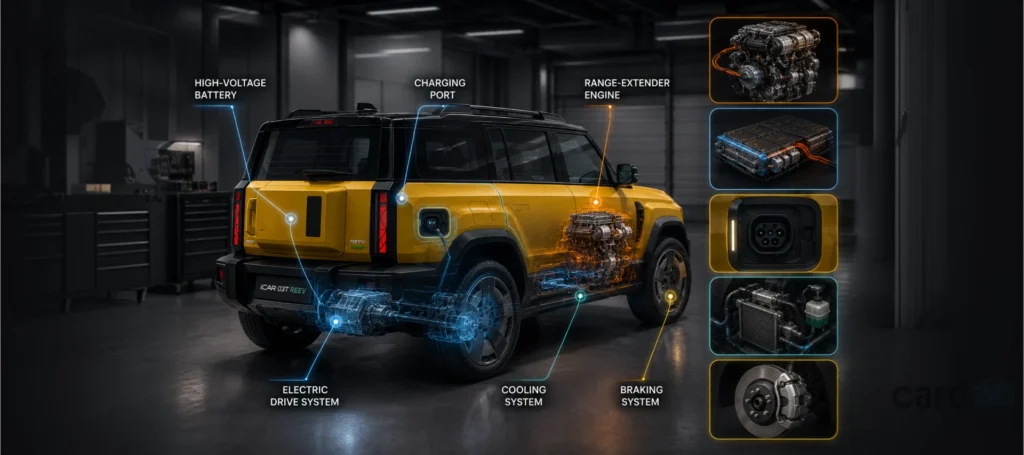
1. Range-Extender Engine Maintenance
Even when the engine does not directly drive the wheels, it is still an internal combustion engine. Its job is to produce electricity for the battery or electric motor when additional energy is required.
Because the engine may run less frequently than the engine in a conventional petrol vehicle, some owners assume it does not need regular servicing. This is incorrect.
The range-extender engine may still require:
- Engine oil changes
- Oil-filter replacement
- Air-filter inspection or replacement
- Spark-plug replacement
- Engine-coolant checks
- Fuel-system inspection
- Belt and hose inspection, depending on the design
- Exhaust and emissions-system checks
Oil can deteriorate because of time, moisture and repeated temperature changes, not only because of distance travelled. This means an oil change may become due even when the engine has accumulated relatively few operating hours.
Always follow the time or mileage interval stated by the manufacturer, whichever comes first. Service schedules differ between models, and manufacturers may recommend shorter intervals when a vehicle operates in demanding conditions. High-Voltage Battery Inspection
The high-voltage battery is one of the most important components in a REEV, but it normally does not require routine owner maintenance.
Battery condition is managed by the vehicle’s battery-management system, which monitors factors such as:
- Battery temperature
- Charging level
- Voltage
- Energy demand
- Charging speed
- Cell performance
During scheduled servicing, trained technicians may use diagnostic equipment to inspect battery performance, cooling operation and stored fault codes.
Owners should not attempt to open, repair or inspect high-voltage components themselves. These systems operate at potentially dangerous voltages and require specialised training and safety equipment.
Drivers should arrange an inspection if they notice a significant unexplained reduction in electric range, repeated battery warnings, reduced power, unusual charging behaviour or unusually frequent operation of the range extender.
3. Battery and Powertrain Cooling Systems
A REEV may contain separate cooling circuits for the battery, electric motor, inverter and petrol engine. Depending on the vehicle, these components may use different types of coolant and may follow different replacement schedules.
Cooling-system maintenance may include:
- Checking coolant levels
- Inspecting hoses and connections
- Testing coolant condition
- Looking for leaks
- Inspecting pumps and valves
- Replacing coolant according to the service schedule
- Confirming that battery thermal management works correctly
Cooling performance is especially important in the UAE, where vehicles regularly operate in high ambient temperatures.
Extreme heat can affect battery performance and charging behaviour. Hyundai’s official EV guidance, for example, recommends parking in shade where possible and notes that connecting the vehicle to a charger can allow its thermal-management system to operate using grid power. Exact behaviour varies by model, so owners should follow the guidance in their vehicle manual. ake Maintenance
REEVs use regenerative braking to recover energy when the vehicle slows down. The electric motor works as a generator, helping reduce the vehicle’s speed while returning energy to the battery.
As a result, the conventional brake pads and discs may be used less frequently than they would be in a petrol vehicle.
However, reduced brake use does not mean the braking system should be ignored. Brake components can still develop:
- Surface corrosion
- Uneven wear
- Sticking calipers
- Contaminated brake fluid
- Damaged seals
- Reduced braking performance
The brake fluid must also be inspected and replaced according to the manufacturer’s schedule. Brake fluid absorbs moisture over time, even when the vehicle has covered relatively little distance.
During servicing, technicians should check the brake pads, discs, calipers, brake fluid and electronic braking controls.
5. Tyre Pressure, Rotation and Alignment
Tyres are one of the most important maintenance areas on any electrified SUV.
Electric motors deliver torque quickly, while batteries can add weight to the vehicle. Depending on driving style, road surfaces and vehicle design, this can contribute to tyre wear.
REEV owners should regularly inspect:
- Cold tyre pressure
- Tread depth
- Uneven shoulder wear
- Sidewall damage
- Wheel alignment
- Wheel balancing
- Tyre age
- Rotation requirements
Check the tyre pressure when the tyres are cold and use the pressure shown on the vehicle’s door-frame label or in the owner’s manual. The US National Highway Traffic Safety Administration advises checking pressure before the vehicle has been driven for approximately three hours, as driving increases tyre temperature and pressure. ducing tyre pressure simply because the reading appears higher during hot weather. Pressure should always be adjusted according to the manufacturer’s cold-pressure recommendation.
6. Charging Port and Charging Cable Care
Even though a REEV can continue travelling by using its range extender, regularly charging the battery allows owners to make greater use of electric driving.
The charging equipment should be treated as part of the vehicle’s maintenance routine.
Before connecting the vehicle, inspect the cable and connector for:
- Cracks or cuts
- Bent or damaged pins
- Burn marks
- Moisture
- Loose connections
- Unusual heat
- Dirt or sand inside the connector
Keep the charging port closed when it is not being used. In dusty environments, sand and debris can collect around the port or connector, so the area should be kept clean and dry.
Never use a visibly damaged cable, and avoid using unapproved adaptors or extension leads. Home charging equipment should be installed and inspected by a qualified professional.
7. Fuel-System Care
A REEV may use less petrol than a conventional vehicle, particularly when it is charged regularly and used mainly for short journeys.
However, petrol does not remain fresh indefinitely. Fuel that sits in the tank for an extended period can gradually deteriorate.
Owners should:
- Use the fuel grade recommended by the manufacturer
- Keep sufficient fuel available for range-extender operation
- Avoid leaving the same fuel unused for excessive periods
- Watch for fuel-system or engine warning lights
- Allow the vehicle’s automatic engine-maintenance functions to operate
- Follow any fuel-refresh guidance in the owner’s manual
Some electrified vehicles automatically run the engine at certain times to maintain the fuel system or engine condition. Do not repeatedly interrupt this process unless the manual specifically allows it.
The exact fuel recommendations and minimum fuel level vary between vehicles, so model-specific instructions should take priority over general advice.
8. The 12-Volt Battery
Like petrol cars and fully electric vehicles, REEVs normally use a conventional 12-volt battery to operate control systems, locks, lights, computers and other low-voltage equipment.
A healthy high-voltage battery does not guarantee that the vehicle will start if the 12-volt battery is weak.
Possible signs of a failing 12-volt battery include:
- The vehicle failing to power on
- Slow or irregular system startup
- Flickering interior lights
- Multiple unexplained warning messages
- Central-locking problems
- Infotainment resets
The 12-volt battery should be tested during routine servicing, particularly before the hottest months of the year. Heat can accelerate battery deterioration, making this an important check for UAE drivers.
9. Air Conditioning and Cabin Filters
Air conditioning is not only a comfort feature in the UAE. In some electrified vehicles, thermal-management systems also rely on related cooling components to help control battery or power-electronics temperatures.
Maintenance may include:
- Replacing the cabin air filter
- Inspecting refrigerant levels
- Checking compressor operation
- Cleaning air intakes
- Inspecting vents for dust or blockage
- Confirming that the cabin cools normally
A blocked cabin filter can reduce airflow and place additional demand on the climate-control system. Owners who regularly drive in dusty areas may need more frequent filter inspections than those operating in cleaner environments.
10. Software and Diagnostic Updates
Modern REEVs depend heavily on software to manage charging, battery temperature, energy flow, engine operation, driver assistance, and regenerative braking.
During a service appointment, the technician may check for updates relating to:
- Battery management
- Charging control
- Range calculation
- Energy efficiency
- Engine operation
- Driver-assistance systems
- Infotainment
- Fault detection
Some updates can be installed remotely, while others may require a workshop visit. Owners should not ignore update notifications, particularly when an update concerns the powertrain, battery or charging system.
Suggested REEV Maintenance Checklist
The following table is a general guide. The official schedule supplied with the vehicle should always be followed.
| Maintenance item | Recommended owner action |
| Engine oil and filter | Replace according to the manufacturer’s time or mileage interval |
| Engine air filter | Inspect during servicing and replace when required |
| High-voltage battery | Have warning messages and unusual range loss professionally diagnosed |
| Battery cooling system | Check coolant and thermal-management operation during scheduled service |
| Brake pads and discs | Inspect regularly despite reduced wear from regenerative braking |
| Brake fluid | Test and replace according to the manufacturer’s schedule |
| Tyres | Check cold pressure regularly and inspect wear, alignment and tread depth |
| Charging cable | Inspect before use for damage, dirt, moisture or overheating |
| Charging port | Keep clean, dry and closed when not in use |
| 12-volt battery | Test during regular servicing and before extreme summer heat |
| Cabin air filter | Inspect more frequently in dusty driving conditions |
| Air conditioning | Check cooling performance and service when required |
| Engine coolant | Inspect level and replace at the specified interval |
| Software | Install relevant manufacturer updates |
| Suspension and steering | Inspect during routine servicing or after strong impacts |
| Wiper blades and washer fluid | Check regularly, especially before long journeys |
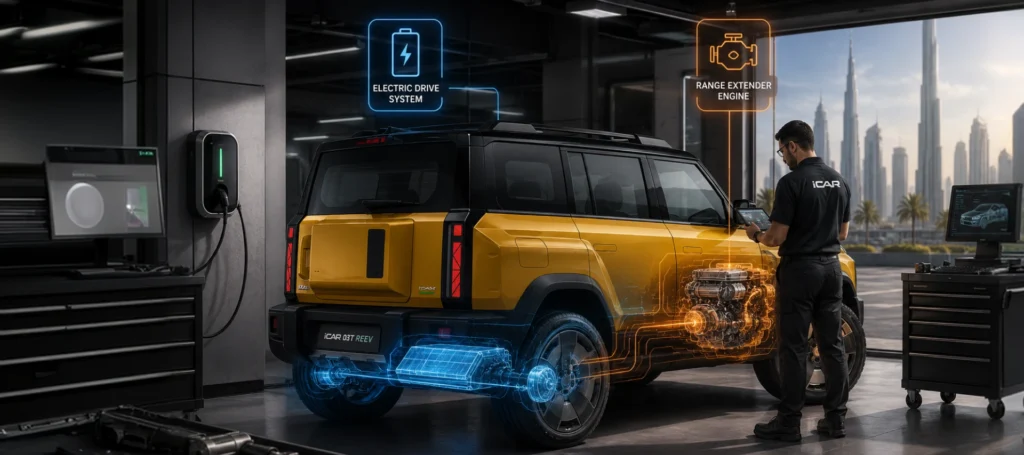
REEV Maintenance in UAE Driving Conditions
Driving conditions in the UAE can place additional demands on several vehicle systems.
High temperatures, airborne dust, frequent air-conditioning use, long periods at motorway speeds and occasional off-road driving may justify more frequent inspections.
REEV owners in Dubai and across the UAE should pay particular attention to:
Cooling Performance
Do not ignore rising temperature warnings, reduced charging speed or unexpectedly limited performance. These may indicate that the vehicle is protecting the battery or powertrain from excessive heat.
Dust and Sand
Inspect cabin filters, engine air filters, charging ports and cooling intakes. Vehicles used in desert or construction areas may collect dust more quickly.
Tyre Condition
Heat, motorway driving and incorrect pressure can increase tyre stress. Inspect the tyres before long journeys and after off-road use.
Air Conditioning
Have weak or inconsistent cooling checked promptly. A poorly performing system can make summer driving uncomfortable and may indicate a refrigerant, compressor or airflow issue.
Parking and Charging
Where practical, park in covered or shaded areas. Use approved charging equipment and keep connectors protected from direct sunlight, water, sand and physical damage.
Warning Signs That Require Professional Inspection
Book a service appointment if you notice:
- A high-voltage battery warning
- A charging-system warning
- Difficulty starting or powering on the vehicle
- A sudden reduction in electric range
- The range extender running much more frequently than normal
- Unusual engine noise or vibration
- Reduced acceleration
- A burning smell
- Fluid underneath the vehicle
- Unusually slow charging
- Excessive heat around the charging connector
- Brake noise or reduced braking performance
- Repeated software or electrical errors
Continuing to drive after a serious battery, charging or cooling-system warning may cause further damage. Follow the instructions displayed by the vehicle and arrange professional assistance when necessary.
Should a REEV Be Serviced at an Authorised Centre?
REEV maintenance requires knowledge of both electric and combustion systems. High-voltage batteries, inverters, electric motors and electronically controlled cooling systems require specialised diagnostic equipment and trained technicians.
Using an authorised service centre can also help owners:
- Follow the correct maintenance schedule
- Receive approved software updates
- Use compatible fluids and replacement parts
- Maintain complete service records
- Identify warranty-related repairs
- Protect the vehicle’s resale value
Keep copies of service invoices and make sure each scheduled visit is recorded. Missing required maintenance could affect warranty coverage, depending on the manufacturer’s terms.
Final Thoughts
REEV maintenance brings together the simpler routine needs of an electric drivetrain with the familiar servicing requirements of a small combustion engine.
The most important rule is not to treat the vehicle as either a conventional petrol car or a maintenance-free EV. Owners should take care of both sides of the system.
Regular servicing, correct tyre pressure, clean charging equipment, healthy cooling systems and timely software updates can help protect efficiency, reliability and long-term battery performance.
For REEV owners in the UAE, additional attention to heat, dust, tyres and air-conditioning performance can make a meaningful difference. Follow the official maintenance schedule, respond quickly to warning messages and use technicians trained in high-voltage vehicle systems.