When choosing an SUV in Dubai, all-wheel drive can sound like the obvious upgrade. More driven wheels, more traction and usually more performance must mean it is the better choice, right?
Not necessarily.
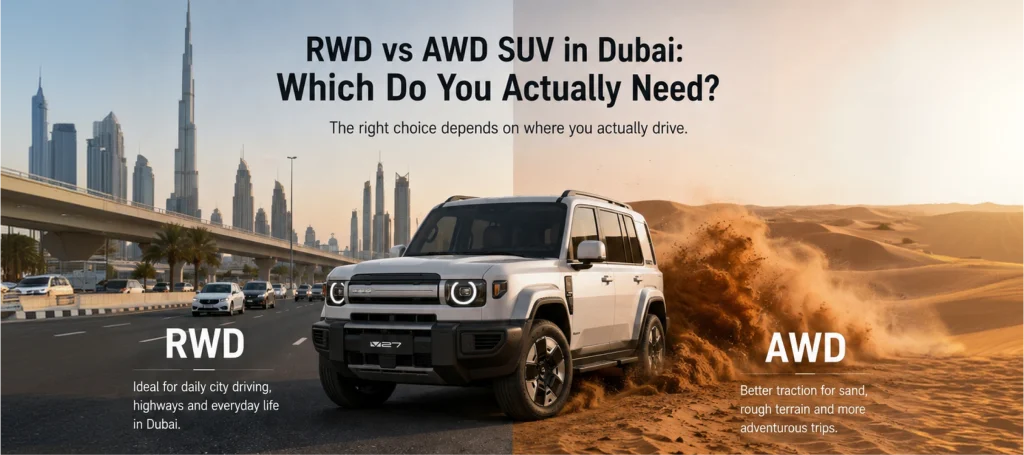
For many UAE drivers who spend most of their time commuting through Dubai, a rear-wheel-drive SUV can already provide everything they need. AWD becomes more valuable when your driving regularly includes loose surfaces, desert trips, difficult terrain or when you simply want stronger performance.
The better choice depends less on which system sounds more capable and more on where you actually drive.
RWD vs AWD: The Simple Difference
Rear-wheel drive, or RWD, sends the vehicle’s driving power to the rear wheels.
All-wheel drive, or AWD, can send power to both the front and rear axles, giving the vehicle additional traction when the road or surface becomes more demanding.
For normal paved-road driving, both systems can work perfectly well. The differences become more noticeable when acceleration, grip and terrain become more demanding.
| Driving Situation | RWD | AWD |
|---|---|---|
| Daily Dubai commuting | Very suitable | Very suitable |
| Highway driving | Very suitable | Very suitable |
| Normal city parking and errands | Very suitable | Very suitable |
| Strong acceleration | Good | Better |
| Loose sand | More limited | Better suited |
| Uneven or low-grip terrain | More limited | Better suited |
| Regular adventure driving | Suitable for lighter use | Better choice |
| Driver prioritising simplicity | Strong choice | More capability |
Is RWD Enough for Driving in Dubai?
For most everyday driving, yes.
Dubai’s main roads, residential areas, highways and shopping districts are paved and well maintained. If your typical week consists of commuting to work, school runs, shopping and motorway journeys, AWD is unlikely to be something you actively need every day.
A modern RWD SUV can still provide strong acceleration, stable motorway driving and comfortable everyday performance.
This makes RWD particularly sensible for drivers who like the size and design of an adventure-style SUV but do not regularly take it onto difficult terrain.
You should therefore avoid thinking of RWD as the “less capable” option. In the right use case, it may simply be the more logical one.
When Does AWD Become Useful in the UAE?
AWD starts to make more sense when your driving regularly moves beyond normal city roads.
The biggest advantage is traction.
On loose sand, gravel, muddy areas or uneven surfaces, spreading power across both axles can help the vehicle maintain grip more effectively than relying only on the rear wheels.
That can be useful for UAE drivers who regularly go camping, explore desert areas, travel on unpaved routes or visit more remote outdoor locations.
AWD can also help when accelerating hard because the available power can be distributed across more tyres rather than relying entirely on one axle.
However, AWD does not automatically turn every SUV into a serious off-roader. Tyres, ground clearance, suspension, driving modes and driver experience remain important when leaving paved roads.
What About Desert Driving?
This is where many Dubai buyers immediately assume AWD is essential.
For proper desert driving or regular use on loose sand, AWD is generally the more appropriate choice because maintaining traction becomes much more important.
Sand creates very different conditions from asphalt. A tyre can lose grip much more easily, particularly when climbing, turning or moving through softer sections.
AWD gives the vehicle more options for distributing power when traction is limited.
If your idea of SUV ownership includes regular desert trips, camping away from paved areas or driving across loose surfaces, choosing AWD makes sense.
If your SUV only leaves the city a few times per year and those trips remain on established roads or easy-access campsites, RWD may still be perfectly adequate.
Does AWD Mean Better Performance?
It can, particularly when the AWD version also comes with an additional electric motor.
The iCAUR V27 is a good example.
The V27 Classic uses a rear-mounted electric motor producing 185 kW and 300 Nm of torque, with a stated 0–100 km/h time of 8.5 seconds.
The Premium and Flagship versions add a front electric motor, creating a dual-motor AWD system with 335 kW of combined motor output and 505 Nm of torque. Their stated 0–100 km/h time drops to 5.9 seconds.
So in this case, choosing AWD is not only about extra traction. It also brings a significant increase in performance.
For everyday drivers, that extra power can be felt when joining a fast motorway, overtaking or accelerating with passengers and luggage on board.
But it is worth asking whether you actually need that additional performance. An 8.5-second 0–100 km/h time is already more than adequate for normal UAE traffic.
Is RWD Better for Everyday Driving?
For the right driver, it can be.
If almost all of your driving happens on paved roads, you may never make full use of an AWD system.
RWD offers a straightforward setup while retaining the driving character and practicality of a large SUV.
In the V27 specifically, the RWD Classic still uses the same REEV concept, so you retain electric-first driving and the range extender for longer journeys without having to choose the higher-output dual-motor system.
This makes it an interesting option for buyers who want the V27 primarily as a spacious everyday SUV rather than for frequent off-road use.
Does AWD Use More Energy?
In general, adding another driven axle and additional drivetrain hardware can increase weight and energy demand.
But you should not choose between two trims based purely on a general assumption that one will always consume significantly more energy.
Battery size, software, motor efficiency, tyres, vehicle weight, driving mode, speed and driving style can all affect real-world consumption.
For a buyer, it is more useful to consider your actual priorities: if you need the extra traction and performance, AWD has a clear purpose. If you do not, there is little reason to choose it simply because four driven wheels sound better.
Which One Should You Choose?
The simplest way to decide is to look at your normal week rather than your most ambitious weekend.
Choose RWD if:
- Most of your driving is inside Dubai.
- You mainly use highways and paved roads.
- You want an SUV for commuting, family use and long-distance road trips.
- Serious off-road driving is rare.
- You do not need the highest-performance version.
Choose AWD if:
- You regularly drive on sand or loose surfaces.
- Camping and outdoor trips are a normal part of your lifestyle.
- You want stronger acceleration.
- You regularly travel on uneven or low-grip terrain.
- Additional traction is important to you.
RWD vs AWD in the iCAUR V27
The V27 makes this choice particularly clear because both types of driver are covered within the same model range.
The V27 Classic RWD is the more straightforward option for someone who wants the size, design, comfort and REEV flexibility of the V27 primarily for everyday road use.
The V27 Premium and Flagship AWD versions are better suited to drivers who want stronger performance and additional capability when conditions become more demanding.
Current UAE specifications list the Premium and Flagship with dual-motor AWD, 335 kW of combined output and 505 Nm of torque, while the Classic uses a 185 kW rear motor producing 300 Nm.
Neither configuration is automatically the right answer for everyone.
The Bottom Line
If you spend almost every day driving between home, work, malls and highways in Dubai, you probably do not need AWD simply because you are buying an SUV.
RWD can be completely suitable for normal city and highway use.
AWD becomes worth considering when the additional traction or performance will genuinely become part of how you use the vehicle, particularly for desert trips, loose surfaces and more adventurous driving.
Instead of asking, “Which drivetrain is better?”, ask a more useful question:
Where will I actually drive this SUV?
For many Dubai drivers, that answer makes the RWD vs AWD decision surprisingly simple.