If you are new to a REEV, regenerative braking is one of the first things you may notice while driving.
Lift your foot off the accelerator and the car may start slowing down more than you expect, even before you touch the brake pedal.
That is regenerative braking at work.
It is not just there to change the way the car feels. It helps recover some of the energy that would normally be lost when the vehicle slows down and sends it back to the battery.
For daily driving in Dubai, where traffic speeds constantly change, that can be genuinely useful.
What Is Regenerative Braking?
In a normal petrol car, slowing down mainly relies on friction brakes. The brake pads press against the discs, turning the car’s movement into heat.
A REEV can recover part of that energy instead.
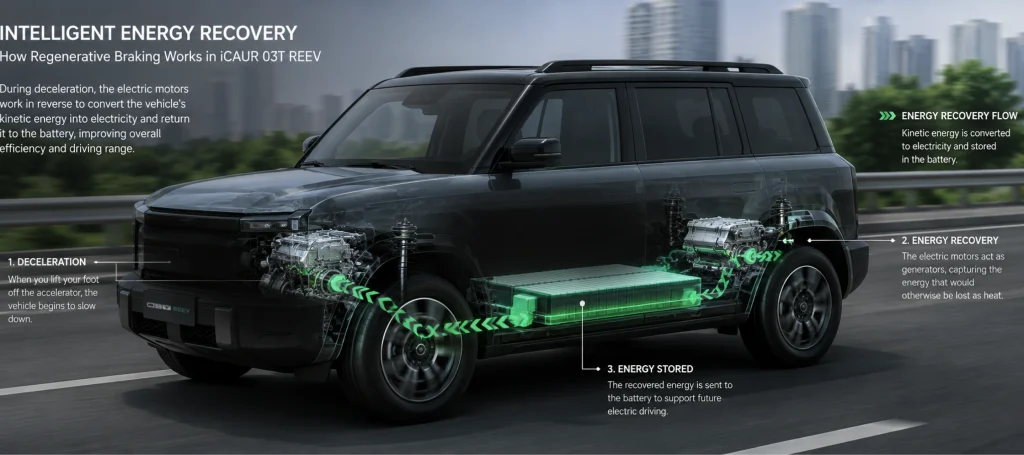
When you slow down, the electric motor can work as a generator. It converts some of the vehicle’s movement back into electrical energy and sends that energy to the battery.
You are not fully recharging the battery every time you slow down. You are simply recovering some energy that would otherwise be wasted.
What Does It Feel Like to Drive?
The biggest difference is usually what happens when you lift off the accelerator.
Instead of continuing to coast for as long as a typical petrol SUV, the vehicle may begin to slow more noticeably.
It can feel unusual at first, but most drivers get used to it quickly.
After some time, you may find yourself lifting off the accelerator earlier when approaching slower traffic, a junction or an exit instead of waiting until the last moment to use the brake pedal.
This can make everyday driving smoother, especially once you understand how strongly your vehicle responds.
Why It Works Well in Dubai Traffic
Regenerative braking is particularly useful when the car is regularly speeding up and slowing down.
That makes Dubai city driving a good example.
Think about a normal commute. You may accelerate away from a traffic light, slow for traffic, speed up again, approach another junction and then reduce speed before joining a different road.
Each time the vehicle slows, there may be an opportunity to recover some energy.
Typical situations include:
- Stop-and-go traffic
- Slowing before a traffic light
- Approaching a highway exit
- Reducing speed in heavier traffic
- Driving downhill
- Everyday urban commuting
On a clear highway where you maintain a steady speed for a long time, there are naturally fewer opportunities for regeneration.
Regenerative Braking vs Normal Brakes
A REEV still has normal brakes.
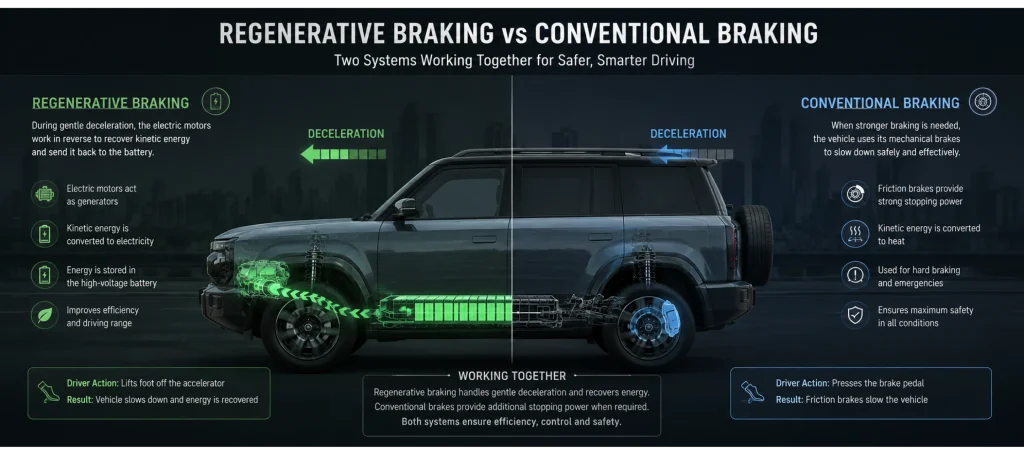
Regenerative braking does not replace the brake pads, discs or the conventional braking system.
Instead, both systems work together.
| Driving Situation | What Usually Happens |
|---|---|
| Gentle slowing | Regenerative braking can handle part of the deceleration |
| Stop-and-go traffic | Regeneration is used frequently |
| Hard braking | Conventional brakes provide stronger stopping force |
| Emergency braking | Normal braking system is essential |
| Gradual downhill driving | Regeneration can recover energy while helping slow the vehicle |
You should always use the brake pedal whenever the situation requires it. Regenerative braking is there to improve efficiency, not to change normal safe braking habits.
Can It Help Your Driving Range?
Yes, but it is important to keep expectations realistic.
Regenerative braking does not create extra energy from nowhere.
Imagine you use battery energy to accelerate the car and then need to stop at the next traffic light.
Without regeneration, most of that movement is eventually lost as heat through the brakes.
With regenerative braking, the car can capture part of that energy and put it back into the battery.
Do this repeatedly during city driving and it can help improve overall efficiency.
That is one reason electrified vehicles can perform well in urban traffic, even though frequent stopping would normally seem inefficient.
Does It Reduce Brake Wear?
It can.
Because the electric motor helps slow the vehicle during normal driving, the friction brakes may be used less often than they would be in a conventional petrol car.
That can reduce wear on brake pads and discs over time.
However, the braking system still needs normal inspection and maintenance. Using the friction brakes less often does not mean they can be ignored.
How Regenerative Braking Works in an iCAUR REEV
iCAUR REEVs use energy recovery as part of their electric drivetrain.
When the vehicle decelerates, some of the energy from that movement can be recovered and returned to the high-voltage battery.
The process happens while you drive. There is no special charging step involved.
It works alongside the rest of the REEV system, where the electric motors drive the wheels and the range extender can support longer-distance driving when required.
For the driver, the technical side stays mostly in the background. What you notice is the way the vehicle slows and how efficiently it manages energy during everyday use.
Is Strong Regenerative Braking Always Better?
Not necessarily.
Strong regeneration can recover energy, but the most efficient driving style is usually the one that avoids wasting energy in the first place.
For example, accelerating hard towards slower traffic and then using strong regeneration is less efficient than accelerating smoothly and anticipating the traffic ahead.
The better habit is simple: look ahead, leave enough distance and avoid unnecessary acceleration and braking.
Regenerative braking should support smooth driving, not become something you constantly try to maximise.
Can Regenerative Braking Feel Different Sometimes?
Yes.
The amount of regenerative braking available may change depending on the vehicle and driving conditions.
Factors can include:
- Battery charge level
- Battery temperature
- Vehicle speed
- Driving mode
- Road conditions
- Vehicle settings
For example, if the battery is already close to full, the vehicle may have less room to store recovered energy. Regenerative braking can therefore feel different from what you experienced at a lower battery level.
This is normal on electrified vehicles.
How to Use It in Everyday Driving
There is no complicated technique to learn.
The easiest approach is to drive smoothly and pay attention to what is happening ahead.
If traffic is slowing, lift off the accelerator a little earlier and allow the car to reduce speed naturally. If you need more stopping power, use the brake pedal as normal.
Avoid unnecessary hard acceleration, keep a sensible distance from the car ahead and give yourself enough space to slow progressively.
After a few drives, you will usually start doing this without thinking about it.
Is Regenerative Braking Useful on Sheikh Zayed Road?
It depends on the traffic.
If traffic is flowing smoothly and you are maintaining a constant speed, regenerative braking will not be doing much because the vehicle is not regularly slowing down.
Once traffic becomes heavier, however, the situation changes.
Every time speeds drop, you approach an exit or traffic begins moving and stopping again, regenerative braking becomes more useful.
So its biggest advantage usually appears during mixed driving rather than long periods of uninterrupted cruising.
The Bottom Line
Regenerative braking is a fairly simple idea.
When your REEV slows down, it can recover some of the energy that would normally be lost and send it back to the battery.
For Dubai drivers, this can be especially useful during regular commuting and stop-and-go traffic. It can help improve efficiency and reduce how often the conventional brakes need to handle gentle slowing.
You do not need to change the way you drive dramatically.
Drive smoothly, look ahead and let the system recover energy when the opportunity is there. The rest happens automatically.