Choosing a new vehicle in the UAE is no longer simply a decision between petrol and diesel. Drivers can now choose from fully electric vehicles, conventional hybrids, plug-in hybrids, and Range-Extended Electric Vehicles, commonly known as REEVs.
Although these technologies may appear similar, they operate in different ways. The most important difference is how the vehicle produces power, how it uses its electric motor and petrol engine, and whether it needs to be charged.
For UAE drivers, these differences can affect everyday convenience, running costs, long-distance confidence, and the overall driving experience. A fully electric vehicle may work perfectly for someone with dependable home charging, while a hybrid may suit a driver who wants improved fuel efficiency without changing their normal routine. A REEV offers another option by combining electric-first driving with the flexibility of a petrol-powered range extender.
This guide explains the difference between an EV, a hybrid, and a REEV and helps you understand which technology may be better suited to driving in Dubai and across the UAE.
What Is an EV?
An Electric Vehicle, or EV, runs entirely on electricity. It does not have a traditional petrol engine, fuel tank, or exhaust system.
Energy is stored in a large battery pack, which sends electricity to one or more electric motors. When the battery becomes low, the vehicle must be connected to an external electricity source such as a home charger, workplace charger, or public charging station.
Because an EV is always driven by an electric motor, it usually provides smooth acceleration, immediate torque, and a quiet cabin.
Main characteristics of an EV
- Powered entirely by electricity
- No petrol engine
- Must be externally charged
- Produces no tailpipe emissions
- Usually offers smooth and quiet acceleration
- Driving range depends entirely on the available battery charge
The UAE is continuing to develop its national charging network as part of the National Electric Vehicles Policy, which aims to support EV ownership and expand charging infrastructure across the country.
Is an EV practical in the UAE?
An EV can be a practical option when charging is easy to access. Drivers who can install a charger at home or regularly charge at their workplace may be able to complete most daily journeys without relying heavily on public infrastructure.
This can work particularly well for predictable journeys such as:
- Daily commuting within Dubai
- School and family trips
- Regular travel between home and work
- Short urban journeys
- Drivers with private parking and home charging
However, charging requires more planning than filling a petrol tank. Apartment residents may not always have a dedicated charging point, and drivers who frequently travel long distances may need to plan their charging stops carefully.
Air-conditioning use, high driving speeds, vehicle load, weather conditions, and driving style can also affect the real-world range of an electric vehicle.
What Is a Hybrid Car?
A conventional hybrid uses both a petrol engine and an electric motor.
Unlike a fully electric vehicle, a standard hybrid usually does not need to be plugged in. Its relatively small battery is charged through regenerative braking and energy produced while the vehicle is running.
The petrol engine remains an important part of the drivetrain. Depending on the design and driving conditions, the engine may power the wheels directly, work together with the electric motor, or switch off temporarily while the vehicle travels at low speed.
Main characteristics of a hybrid
- Uses a petrol engine and electric motor
- Usually does not require external charging
- The battery is charged while driving
- A petrol engine can directly power the wheels
- Often consumes less fuel than a comparable conventional petrol car
- Electric-only driving is normally limited
A hybrid can make city driving more efficient because the electric motor assists during acceleration and low-speed operation. Regenerative braking also recovers energy that would otherwise be lost when slowing down.
Is a hybrid practical in the UAE?
A hybrid is often the easiest electrified vehicle to adapt to because it does not normally require a change in refuelling habits.
You continue filling the vehicle with petrol in the usual way, while the hybrid system automatically manages the engine, electric motor, and battery.
This may suit UAE drivers who:
- Cannot charge at home
- Want lower fuel consumption
- Regularly drive in stop-and-go traffic
- Prefer familiar petrol refuelling
- Do not want to plan journeys around charging stations
The main limitation is that a conventional hybrid does not provide the same electric-first experience as an EV or REEV. Its battery is smaller, its electric-only range is limited, and the petrol engine remains actively involved in normal driving.
What Is a REEV?
REEV stands for Range-Extended Electric Vehicle. It may also be called an EREV, or Extended-Range Electric Vehicle.
A REEV contains a battery, an electric motor, and a petrol engine. However, it does not operate in the same way as a typical hybrid.
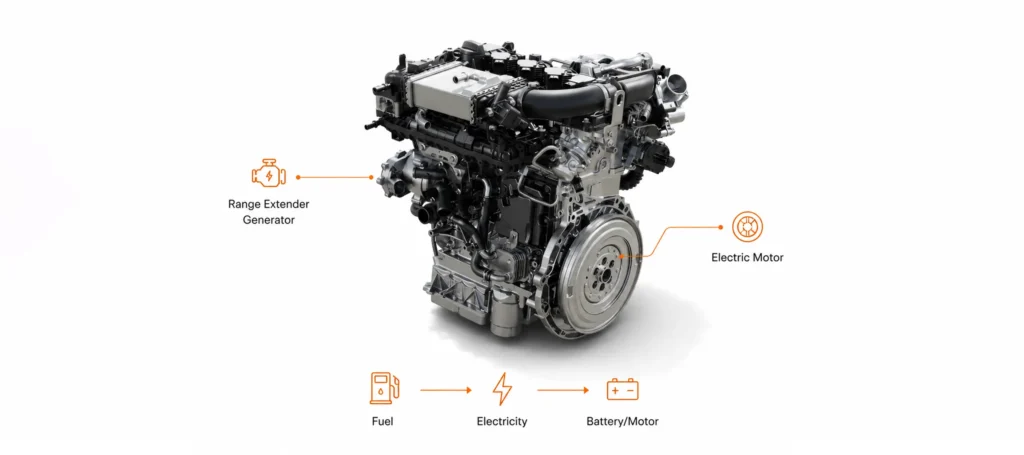
In a REEV, the electric motor is the main source of propulsion. The petrol engine normally functions as a generator, producing electricity when additional energy is needed. In a series-type REEV system, the engine is not mechanically connected to the drive axle.
This means the vehicle can preserve many characteristics associated with electric driving, including smooth acceleration and immediate response, while the range extender provides additional flexibility when the battery charge becomes low.
How does a REEV work?
A REEV generally operates through the following process:
- The battery provides electricity to the electric motor.
- The electric motor drives the vehicle.
- During shorter journeys, the vehicle may operate primarily on stored battery energy.
- When additional energy is required, the petrol engine starts.
- The engine powers a generator that produces electricity for the battery or motor.
- The vehicle continues to be propelled electrically.
Many REEVs can also be connected to an external charger, allowing the driver to begin a journey with a charged battery.
Main characteristics of a REEV
- The electric motor is the main source of propulsion
- Can usually be externally charged
- Includes a petrol-powered range extender
- The engine primarily generates electricity
- Offers electric-first driving with extended-distance flexibility
- Can continue travelling without depending entirely on a charging station
What Is the Main Difference Between an EV, Hybrid and REEV?
The simplest way to understand the three systems is to look at what actually drives the wheels.
In an EV, the wheels are always driven by an electric motor.
In a conventional hybrid, the petrol engine can directly drive the wheels, while the electric motor provides assistance.
In a REEV, the electric motor normally drives the wheels, while the petrol engine produces electricity to extend the available driving range.
| Feature | Electric Vehicle (EV) | Hybrid Vehicle | Range-Extended Electric Vehicle (REEV) |
|---|---|---|---|
| Main propulsion source | Electric motor | Petrol engine and electric motor | Electric motor |
| Petrol engine | No | Yes | Yes, mainly used to generate electricity |
| External charging | Required | Usually not required | Usually supported and recommended |
| Electric-only driving | Full-time | Limited | Available for daily journeys, depending on battery capacity |
| Petrol refuelling | Not required | Required | Required when using the range extender |
| Dependence on charging infrastructure | High | Low | Lower than a fully electric vehicle |
| Driving experience | Fully electric, quiet and responsive | Combination of petrol and electric power | Electric-first, smooth and responsive |
| Long-distance flexibility | Depends on battery range and charging access | High | High, with support from the petrol-powered range extender |
| Tailpipe emissions | None | Yes | Yes, when the range extender is operating |
| Best suited to | UAE drivers with reliable home or workplace charging | Drivers who want better fuel efficiency without plugging in | Drivers who want electric-first performance with long-distance flexibility |
Is a REEV the Same as a Plug-In Hybrid?
A REEV and a Plug-in Hybrid Electric Vehicle, or PHEV, can both contain a rechargeable battery, an electric motor, and a petrol engine. However, their drivetrain layouts are not necessarily the same.
In many plug-in hybrids, the petrol engine can directly power the wheels. The electric motor and engine may operate separately or work together depending on the driving situation.
In a REEV, the electric motor remains the primary driving source. The engine is mainly used to generate electricity rather than provide direct mechanical power to the wheels.
A simple way to remember the distinction is:
A plug-in hybrid is generally a hybrid that can be charged. A REEV is generally an electric vehicle with an onboard range extender.
Exact system designs can vary between manufacturers, so drivers should always review the specifications of the individual vehicle.

Which One Provides the Best Driving Experience?
Driving experience is subjective, but the three systems have noticeable differences.
EV driving experience
An EV generally provides the purest electric driving experience. Acceleration is smooth and immediate, the cabin is quiet, and there are no engine starts or traditional gear changes in many models.
However, the driver must pay closer attention to battery range and charging availability.
Hybrid driving experience
A hybrid can feel familiar to anyone moving from a conventional petrol car. The vehicle automatically switches between its available power sources, but the engine may frequently start and stop during the journey.
The experience can be efficient and convenient, although it may not feel consistently electric.
REEV driving experience
A REEV is designed to maintain an electric-first character. Since the electric motor handles propulsion, acceleration can remain smooth and responsive even when the range extender is operating.
The engine may still be heard when it starts to generate electricity, but its role is different from the engine in a conventional hybrid.
Which Is Better for Daily Driving in Dubai?
Daily driving in Dubai can include congested streets, long periods of air-conditioning use, multi-lane highways, underground parking, and frequent short journeys.
An EV can work very well when the driver has reliable charging at home or work. Starting every morning with a charged battery can make daily commuting convenient.
A hybrid may be easier for drivers without access to charging. It can improve efficiency in urban traffic while maintaining the familiar routine of petrol refuelling.
A REEV may suit drivers who want to complete regular journeys using stored electricity but still want a petrol-supported reserve for longer or less predictable trips.
The right choice depends less on the technology itself and more on your parking, charging access, daily distance, and travel routine.
Which Is Better for Long-Distance UAE Driving?
Long-distance driving in the UAE may involve travelling from Dubai to Abu Dhabi, Ras Al Khaimah, Fujairah, Al Ain, or more remote destinations.
A fully electric vehicle can complete these journeys, but the driver must consider the vehicle’s actual range and the availability of suitable charging stations along the route.
A hybrid offers straightforward long-distance travel because petrol stations are widely available and refuelling takes only a few minutes.
A REEV offers similar route flexibility while maintaining electric motor propulsion. When the battery level decreases, the onboard range extender can generate additional electricity, reducing the need to stop immediately at a charger.
For drivers who regularly combine urban commuting with inter-emirate travel or weekend trips, this flexibility can be particularly valuable.
Which Vehicle Is Cheaper to Run?
Running costs depend on several factors, including electricity prices, petrol prices, vehicle efficiency, driving distance, charging habits, maintenance requirements, and insurance.
EV running costs
An EV can be economical when most charging is completed at home. Electric vehicles also have fewer traditional engine components, which may reduce some routine mechanical maintenance requirements.
However, public rapid charging may cost more than home charging, and the installation of a private charger may create an initial expense.
Hybrid running costs
A hybrid can reduce petrol consumption without requiring charging equipment. Savings depend on how efficiently the hybrid system operates and where the vehicle is driven.
Hybrids often provide their greatest efficiency advantage in urban traffic, where regenerative braking and electric assistance are used frequently.
REEV running costs
A REEV can be economical when charged regularly and used primarily on battery power for daily journeys.
When the range extender operates frequently, petrol consumption becomes a more important part of the running cost. Owners who rarely charge the battery may not receive the full efficiency benefit of the system.
The most effective way to use a chargeable REEV is generally to charge it regularly and treat the petrol engine as additional support rather than the primary energy source.
What Happens When the Battery Runs Low?
This is another major difference between the three vehicle types.
In an EV
When the battery becomes low, the vehicle needs to reach a charging point. There is no petrol engine to create additional driving range.
In a hybrid
The petrol engine continues operating as required. The small hybrid battery is automatically charged and discharged by the vehicle.
In a REEV
The petrol-powered range extender can start generating electricity, allowing the electric motor to continue driving the vehicle. The driver can later recharge the battery or refill the petrol tank as needed.
Do EVs, Hybrids and REEVs All Use Regenerative Braking?
Yes, all three vehicle types can use regenerative braking.
Regenerative braking allows the electric motor to operate in reverse when the vehicle slows down. Instead of wasting all the vehicle’s movement as heat through the brakes, the system recovers part of that energy and sends it back to the battery.
The amount of energy recovered varies according to the vehicle, battery condition, speed, driving mode, and braking intensity.
In an EV or REEV, regenerative braking can contribute directly to electric driving range. In a conventional hybrid, it helps recharge the smaller battery and reduces the amount of work required from the petrol engine.
Which Technology Requires the Least Planning?
A conventional hybrid normally requires the least lifestyle adjustment. You fill the petrol tank and drive it much like a traditional vehicle.
A REEV requires slightly more planning if you want to benefit fully from its battery. Regular charging helps maximize electric driving, but the range extender provides support when charging is unavailable.
A fully electric vehicle requires the most attention to charging access, particularly for drivers without a private charger or those travelling beyond their normal routes.
EV vs Hybrid vs REEV: Advantages and Limitations
EV advantages
- Fully electric driving
- No tailpipe emissions
- Quiet and responsive performance
- No petrol required
- Potentially lower routine powertrain maintenance
EV limitations
- Entirely dependent on battery charge
- Charging may take longer than refuelling
- Home charging may not be available to every resident
- Long journeys can require additional planning
Hybrid advantages
- No external charging is normally required
- Familiar refuelling process
- Potentially lower fuel consumption than a conventional petrol car
- Convenient for urban and long-distance driving
Hybrid limitations
- Limited electric-only driving
- The petrol engine remains an active propulsion source
- Does not provide a consistently electric driving experience
- Still dependent on petrol
REEV advantages
- The electric motor remains the main propulsion source
- Can support electric daily commuting
- Range extender reduces dependence on public charging
- Suitable for mixed city and long-distance use
- Smooth electric-style acceleration
- Offers petrol refuelling as an additional option
REEV limitations
- More mechanically complex than a full EV
- Still produces emissions when the petrol engine operates
- Best efficiency depends on regular charging
- Requires both charging and petrol-related systems
- Engine operation may occasionally be noticeable
Which One Is Right for You?
There is no single powertrain that is best for every UAE driver.
Choose an EV when:
You have reliable access to charging, your daily mileage is predictable, and you are comfortable planning longer journeys around charging locations.
Choose a hybrid when:
You want improved fuel efficiency without plugging in, changing your routine, or depending on charging infrastructure.
Choose a REEV when:
You want electric-first driving but frequently travel beyond your normal daily route. It can also be a practical choice when home charging is available, but public charging access during longer trips remains a concern.
Why REEV Technology Makes Sense for Some UAE Drivers
The UAE is rapidly developing its EV infrastructure, but every driver has a different level of access to charging. Some residents can charge at home every night, while others rely on shared residential parking or public charging facilities.
REEV technology helps bridge that gap.
During daily journeys, the vehicle can use stored electrical energy. When the journey becomes longer or charging is not immediately available, the range extender can produce electricity and keep the vehicle moving.
This combination can be particularly relevant for drivers whose routines include:
- Daily commuting in Dubai
- Regular inter-emirate travel
- Weekend journeys outside the city
- Unpredictable business travel
- Limited charging access at certain destinations
- A preference for smooth electric motor performance
REEVs are increasingly being positioned as a practical bridge between conventional hybrid vehicles and fully battery-electric cars, particularly in markets where drivers want electric propulsion without relying completely on charging infrastructure.
Discover iCAUR REEV SUVs in Dubai
iCAUR approaches modern SUV design through a combination of bold styling, intelligent technology, adventure-ready capability, and electric-first performance.
Its REEV models are designed to provide the smooth response of electric motor propulsion while offering additional range confidence through an onboard petrol-powered generator.
For UAE drivers, this means a vehicle can feel well suited to everyday city driving while remaining prepared for longer highway journeys and weekend travel.
The best way to understand the difference is to experience it from behind the wheel. Visit the iCAUR showroom in Dubai to explore available models, learn more about REEV technology, and book a test drive with the iCAUR Autorun in Dubai team.