For most Dubai drivers, the running-cost comparison between a REEV and a petrol SUV comes down to one simple question: how much of your everyday driving can you do on electricity?
A Range-Extended Electric Vehicle, or REEV, can handle regular trips using battery power and keep a petrol range extender available for longer journeys. That can make a noticeable difference to monthly driving costs, particularly if you can charge at home.
To make the comparison practical, we will look at a driver covering around 50 km per day, or 1,500 km per month, and compare a conventional petrol SUV with the iCAUR 03T REEV.
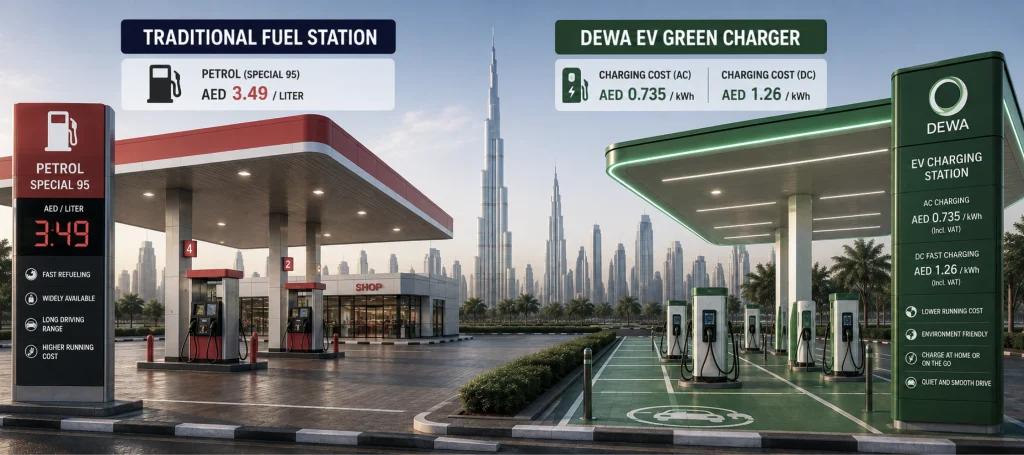
Current Petrol and Charging Costs in Dubai
As of August 2026, UAE Special 95 petrol costs AED 3.49 per litre. Super 98 is AED 3.60 and E-Plus 91 is AED 3.41 per litre.
For home charging in Dubai, DEWA residential electricity currently starts at AED 0.23/kWh and rises depending on the household’s consumption slab. The August 2026 electricity fuel surcharge is AED 0.06/kWh, and 5% VAT applies. This puts the effective electricity rate at roughly AED 0.305 to AED 0.462 per kWh, depending on your existing household consumption.
At DEWA public chargers, the applicable rate is AED 0.70/kWh plus VAT for AC charging and AED 1.20/kWh plus VAT for DC fast charging.
| Energy Source | Current Cost |
|---|---|
| Special 95 Petrol | AED 3.49/L |
| Home Charging | Approx. AED 0.305–0.462/kWh |
| DEWA Public AC Charging | AED 0.735/kWh incl. VAT |
| DEWA Public DC Charging | AED 1.26/kWh incl. VAT |
What Would a Petrol SUV Cost Per Month?
For a straightforward example, assume a petrol SUV consumes 8 L/100 km.
At 1,500 km per month, it would use approximately 120 litres of petrol.
At the current Special 95 price of AED 3.49 per litre:
Estimated monthly fuel cost: AED 419
That works out to approximately AED 27.90 per 100 km.
Of course, an efficient compact SUV may use less than 8 L/100 km, while a larger or more powerful SUV may use considerably more. The figure is simply a useful benchmark for comparing everyday running costs.
What Would an iCAUR 03T REEV Cost?
The iCAUR 03T REEV uses a 34.31 kWh battery, offers up to 171 km of WLTC electric range, and uses 95 RON petrol when the range extender is required. Its stated low-state-of-charge fuel consumption is 6.7 L/100 km.
A 50 km daily commute therefore sits well within its rated electric range when the battery is sufficiently charged.
Using the battery capacity and rated electric range as a simple energy-cost estimate, here is what 1,500 km of predominantly electric driving could cost:
| Driving Method | Approx. Cost per 100 km | Approx. Monthly Cost at 1,500 km |
|---|---|---|
| iCAUR 03T – Home Charging | AED 6.10–9.30 | AED 92–139 |
| iCAUR 03T – Public AC Charging | AED 14.75 | AED 221 |
| iCAUR 03T – Public DC Charging | AED 25.30 | AED 379 |
| Petrol SUV – 8 L/100 km | AED 27.90 | AED 419 |
These are energy-cost estimates rather than guaranteed real-world figures. Charging losses, air-conditioning, high-speed motorway driving, outside temperature and driving style can all increase consumption.
Still, the difference shows why home charging is particularly important for REEV ownership.
What If You Do Not Charge the REEV Regularly?
This is one of the most important points for anyone considering a REEV.
A REEV does not need to be plugged in every time you drive. Once battery charge becomes low, the petrol range extender allows the vehicle to continue travelling.
However, if you rarely charge it, you lose much of the running-cost advantage.
Using the iCAUR 03T’s stated low-SOC consumption of 6.7 L/100 km and today’s Special 95 petrol price, covering 1,500 km mainly with the range extender would cost roughly:
AED 351 per month
That is still below our 8 L/100 km petrol SUV example at AED 419, but the difference is much smaller than when the REEV is charged regularly.
In other words, buying a REEV and never plugging it in is not the most economical way to use it.
A More Realistic Dubai Driving Example
Most REEV owners are unlikely to drive exclusively on electricity or exclusively using the range extender.
Imagine that during a normal month you complete 80% of your 1,500 km on battery power and use petrol for the remaining 20%.
If most charging is done at home, the estimated energy cost would be around:
AED 143 to AED 181 per month
The same 1,500 km in our 8 L/100 km petrol SUV would cost approximately:
AED 419 per month
That represents a potential difference of roughly AED 238 to AED 276 every month in this example.
The exact saving will depend heavily on where you charge and how often the petrol range extender is used.

Home Charging vs Public Charging Matters
For a Dubai driver considering a REEV, access to home or workplace charging can make a bigger financial difference than many people expect.
Home charging offers the lowest electricity cost in our comparison. Public AC charging is still relatively economical, but regular DC fast charging costs considerably more.
DC charging is useful when you need to add energy quickly during a longer trip, but using it for every charge reduces the cost advantage compared with petrol.
For everyday use, the most economical routine is usually simple: charge at home when convenient, use battery power for normal commuting, and keep the range extender for longer journeys or days when charging is not practical.
What Can Increase Your Real Driving Cost?
Dubai driving conditions can affect both petrol and electric vehicles.
Heavy use of air conditioning during summer, sustained highway speeds, aggressive acceleration, heavier loads and frequent long-distance driving can all increase energy use.
For a REEV, another important factor is how much time the vehicle spends with a low battery. The more regularly you plug in, the more of your daily mileage can be covered using lower-cost electricity.
Your home electricity tariff also depends on which DEWA consumption slab your household is already in, so two owners driving exactly the same vehicle may not pay exactly the same amount to charge it.

So, Is a REEV Cheaper Than a Petrol SUV in Dubai?
For a driver who can charge regularly, yes, the everyday energy cost can be significantly lower.
In our 1,500 km monthly example:
- Petrol SUV: around AED 419
- iCAUR 03T using mainly home charging: around AED 92 to AED 139
- 03T with a realistic 80% electric / 20% petrol mix: around AED 143 to AED 181
The advantage becomes smaller if you rely heavily on public DC charging or rarely plug the vehicle in.
That is really the key difference between a REEV and a conventional petrol SUV. A petrol SUV gives you essentially one energy source. A REEV gives you a choice.
For daily commuting around Dubai, electricity can handle much of the routine driving at a lower cost. When you need to travel farther across the UAE, the petrol range extender remains available without making the trip dependent entirely on charging stops.