Drivers in the UAE now have more electrified vehicle options than ever before. Alongside fully electric vehicles, the market includes traditional hybrids, plug-in hybrids, and a growing category known as Range-Extended Electric Vehicles, or REEVs.
At first glance, a REEV SUV and a traditional hybrid SUV may appear very similar. Both have a battery, an electric motor, a petrol engine, and a fuel tank. However, the way these components work together is significantly different.
The simplest way to understand the difference is this:
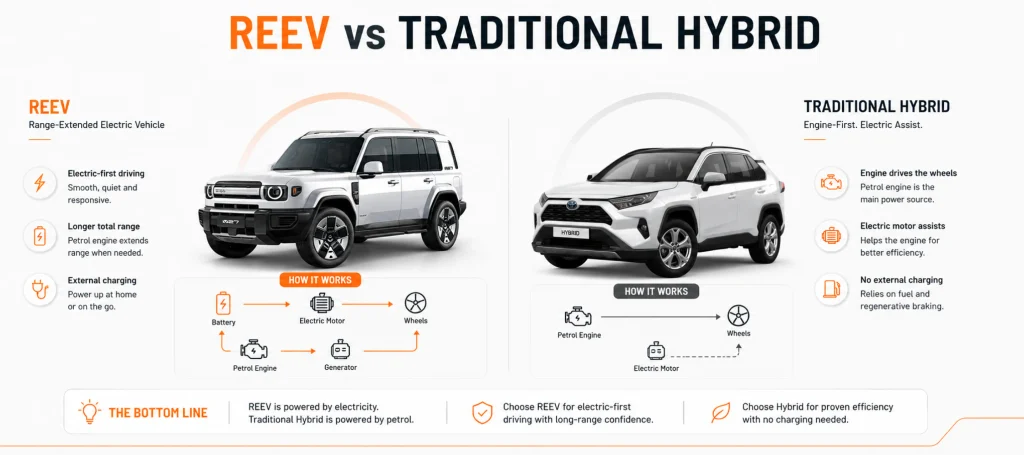
A traditional hybrid is primarily a petrol-powered vehicle supported by an electric motor. A REEV is primarily an electric vehicle supported by a petrol-powered generator.
That difference affects how the vehicle accelerates, how often it uses petrol, whether it can be charged, and how it feels during everyday driving.
What Is a Traditional Hybrid SUV?
A traditional hybrid SUV, sometimes called a self-charging hybrid or HEV, combines a petrol engine with one or more electric motors.
Depending on the speed, battery level, and driving conditions, the vehicle may be powered by:
- The petrol engine
- The electric motor
- Both systems working together
The petrol engine can directly send mechanical power to the wheels. The electric motor assists when additional power is needed and may also move the vehicle independently for short periods, particularly at low speeds.
Traditional hybrids normally have relatively small traction batteries. These batteries are charged through regenerative braking and by the petrol engine, rather than by connecting the vehicle to an external charger.
This means the driver uses a traditional hybrid much like a normal petrol vehicle. You fill the fuel tank and drive without needing to plan charging sessions.
What Is a REEV SUV?
REEV stands for Range-Extended Electric Vehicle. It may also be described as an extended-range electric vehicle or range-extender hybrid.
In a typical REEV SUV, electric motors are responsible for driving the wheels. The vehicle uses electricity stored in a larger battery to provide most or all of its propulsion.
The petrol engine has a different role. Instead of acting as the vehicle’s main source of mechanical power, it primarily operates as a generator. When the battery reaches a certain level, the engine starts and produces electricity to support the battery and electric motors.
The result is an electric-first driving experience with the additional reassurance of a petrol-powered range extender.
REEVs can usually be connected to an external charging source, allowing drivers to recharge the battery at home, at work, or at a public charging station. Like other plug-in electrified vehicles, they can also recover some energy through regenerative braking.
REEV SUV vs Traditional Hybrid SUV
| Feature | REEV SUV | Traditional Hybrid SUV |
|---|---|---|
| Main source of propulsion | Electric motor | Petrol engine and electric motor |
| Role of the petrol engine | Primarily generates electricity | Can directly drive the wheels |
| External charging | Usually supported | Not normally supported |
| Battery size | Generally larger | Generally smaller |
| Electric-only driving | Designed for meaningful daily distances | Usually limited to short distances |
| Driving experience | More consistently electric | Switches between petrol and electric operation |
| Energy sources | Electricity and petrol | Mainly petrol |
| Long-distance support | Petrol generator extends the electric driving range | Petrol engine provides much of the power |
| Best suited for | Drivers wanting electric daily driving with long-range flexibility | Drivers wanting improved efficiency without regular charging |
The Most Important Difference Is What Drives the Wheels
The biggest difference between the two systems is not simply battery size or whether the vehicle has a charging port. It is how power reaches the wheels.
In a traditional hybrid, the petrol engine remains an active part of the propulsion system. It can directly drive the wheels through the vehicle’s transmission. The electric motor works alongside it to improve efficiency, support acceleration, and reduce fuel consumption.
In a typical REEV, the electric motor remains the main source of propulsion. The petrol engine’s primary task is to generate electricity when the battery requires additional support.
This gives the two vehicles noticeably different personalities.
A traditional hybrid often feels like a refined and efficient petrol SUV. A REEV generally feels closer to a fully electric SUV, even when the range extender is operating.
A REEV Usually Provides a More Electric Driving Experience
Electric motors deliver torque quickly and smoothly. Because a REEV depends on its electric motors for propulsion, acceleration can feel immediate and consistent.
There is normally no need to wait for a petrol engine to build revs or for a conventional transmission to change gears. This can make a REEV feel particularly comfortable in situations such as:
- Moving through stop-and-go traffic in Dubai
- Joining faster roads
- Overtaking on a highway
- Driving through crowded car parks
- Climbing an incline with passengers and luggage
Traditional hybrids can also feel smooth, particularly at low speeds. However, the petrol engine may start and stop more frequently as power demands and battery levels change.
That transition is often well managed in modern hybrid SUVs, but the driving experience is still based on two propulsion sources sharing responsibility.
Traditional Hybrids Do Not Need to Be Plugged In
Convenience is one of the strongest advantages of a traditional hybrid.
The driver does not need access to a home charger or public charging network. The vehicle manages its smaller battery automatically, using regenerative braking and energy produced by the engine.
For drivers who live in buildings without practical charging access, a traditional hybrid can offer improved efficiency without requiring a change in routine.
A REEV is more flexible than a fully electric vehicle because it can continue travelling with petrol when charging is not available. However, regular charging is still important if the owner wants to gain the full benefit of electric-first driving.
A REEV that is rarely charged may rely more frequently on its petrol range extender. It will still function, but it may not deliver the same fuel-saving and electric-driving advantages as it would with regular charging.
Battery Size and Electric Range
Traditional hybrids generally use smaller batteries because their electric motors are designed to assist the petrol engine rather than replace it for extended journeys.
A traditional hybrid may move on electric power while parking, travelling slowly, or coasting. However, the petrol engine will usually start when the vehicle requires stronger acceleration, reaches higher speeds, or needs to maintain battery charge.
A REEV normally has a considerably larger battery. It is intended to complete a meaningful portion of daily driving using stored electricity.
For a driver who can charge regularly, this may mean that many commutes, school runs, shopping trips, and local journeys can be completed with little or no petrol consumption. The engine remains available for longer journeys or situations in which the battery cannot be recharged.
Actual electric range will always depend on the vehicle, battery capacity, speed, driving style, passenger load, air-conditioning use, terrain, and weather conditions.
What Happens on a Long Journey?
This is where the flexibility of a REEV becomes particularly useful.
Imagine leaving Dubai with a fully charged battery for a longer drive across the UAE. The vehicle initially uses electricity stored in the battery. Once the battery reaches a predetermined level, the petrol range extender can start generating electricity.
There is no need to stop immediately and search for a charger. As long as petrol is available, the range extender can continue supporting the electric drive system.
A traditional hybrid handles a long journey differently. Its petrol engine will operate as a direct source of propulsion for much of the drive, while the electric motor assists whenever the system determines that doing so would improve performance or efficiency.
Both vehicles reduce the pressure associated with relying entirely on public charging, but they achieve this in different ways.
The REEV extends an electric driving system. The traditional hybrid improves a petrol driving system.
Which One Uses Less Petrol?
There is no single answer because fuel consumption depends heavily on how the vehicle is used.
A REEV can use very little petrol during daily driving when:
- The battery is charged regularly
- Daily journeys fit within the available electric range
- The vehicle spends most of its time in electric mode
- The range extender is mainly reserved for occasional longer trips
A traditional hybrid can be highly efficient without any charging routine. It automatically reduces fuel use by recovering energy during braking, switching off the engine when appropriate, and using electric assistance when it is most effective.
However, a REEV may consume more petrol than expected if it is driven for long distances without being charged regularly. Producing electricity through a petrol engine and then sending that electricity to the motors involves energy conversion losses.
The best choice therefore depends not only on the technology but also on the owner’s charging access and driving habits.
How Are REEVs and Traditional Hybrids Similar?
Despite their differences, the two systems share several features.
Both use regenerative braking, which captures some of the energy normally lost during deceleration and stores it in the battery. Both can reduce fuel consumption compared with a similarly sized conventional petrol vehicle under suitable driving conditions.
They also both retain an internal combustion engine. This means they require engine-related maintenance, including items such as engine oil, filters, cooling systems, and other components specified by the manufacturer.
A REEV is not the same as a fully electric vehicle. When its petrol engine operates, it consumes fuel and produces tailpipe emissions. Electrified vehicles generally produce fewer tailpipe emissions than conventional vehicles under many operating conditions, while electric-only operation produces no direct tailpipe emissions during that portion of the journey.
Which Technology Is Better for UAE Driving?
Neither system is automatically better for every driver.
A traditional hybrid may be more suitable for someone who:
- Cannot charge at home or work
- Wants improved fuel economy without changing existing driving habits
- Frequently covers long distances
- Prefers to rely mainly on petrol stations
- Does not require extended electric-only driving
A REEV may be more suitable for someone who:
- Wants an electric-style driving experience
- Has access to regular charging
- Wants to complete daily journeys mainly on electricity
- Occasionally travels beyond the available battery range
- Wants the reassurance of petrol support on longer journeys
- Is not yet ready to depend completely on public charging
For UAE drivers, a REEV can provide a practical middle ground. Daily city driving can be completed using the battery, while the range extender provides additional confidence for inter-emirate journeys, highway travel, and weekend trips.
The petrol engine does not remove the value of charging. Instead, it provides a backup energy source when the journey continues beyond the available battery charge.
Is a REEV the Same as a Plug-In Hybrid?
The categories can overlap, and terminology sometimes varies between manufacturers and markets.
Both REEVs and plug-in hybrid vehicles generally have chargeable batteries, electric motors, petrol engines, and fuel tanks.
The main distinction is the system’s design priority.
In many plug-in hybrids, both the petrol engine and electric motor can directly drive the wheels. Once the available electric range is used, the vehicle may operate more like a conventional hybrid.
In a typical REEV, the electric motors remain responsible for propulsion, while the petrol engine primarily generates electricity. This allows the vehicle to maintain a more consistent electric driving character.
Because manufacturers use different powertrain designs, buyers should always check how a particular model’s engine, motors, battery, and transmission work rather than relying only on the marketing category.
How iCAUR Uses REEV Technology
iCAUR is developing adventure-ready SUVs around range-extender powertrains. Models including the iCAUR V27 and iCAUR 03T were introduced in Dubai with REEV systems designed to combine electric propulsion with extended driving flexibility.
This approach suits drivers who want the smooth response and modern character of an electric SUV but also need the confidence to travel farther without depending entirely on the next charging stop.
It can be particularly relevant in the UAE, where a vehicle may be used for short urban commutes during the week and significantly longer highway or recreational journeys at the weekend.
Final Thoughts
A traditional hybrid SUV and a REEV SUV both combine petrol and electric technology, but they begin from different ideas.
A traditional hybrid starts with a petrol vehicle and uses electric assistance to make it more efficient. A REEV starts with an electric vehicle and adds a petrol generator to make longer journeys easier.
For drivers who do not have reliable charging access, a traditional hybrid remains a convenient and efficient choice. For those who want to drive mainly on electricity while retaining the flexibility of petrol support, a REEV offers a different type of ownership experience.
The right choice depends on where you drive, how often you travel long distances, and whether you can charge regularly. Understanding how each system operates will help you choose an SUV that fits your real daily routine rather than simply selecting the newest powertrain label.
Explore the latest iCAUR REEV SUVs in Dubai with Autorun, learn more about available models, and book an iCAUR test drive in Dubai to experience how electric-first performance feels on the road.