Ground clearance is one of those SUV specifications that sounds important, but many buyers are not quite sure what it means in everyday driving.
Is 180 mm enough? Is 220 mm much better? And if an SUV has high ground clearance, does that automatically mean it is good for desert driving?
For drivers in Dubai and across the UAE, the answer depends on where the vehicle will actually be used. Ground clearance can help with everything from steep parking ramps to rough tracks, but it is only one part of an SUV’s overall capability.
Here is what you actually need to know.
What Is Ground Clearance?
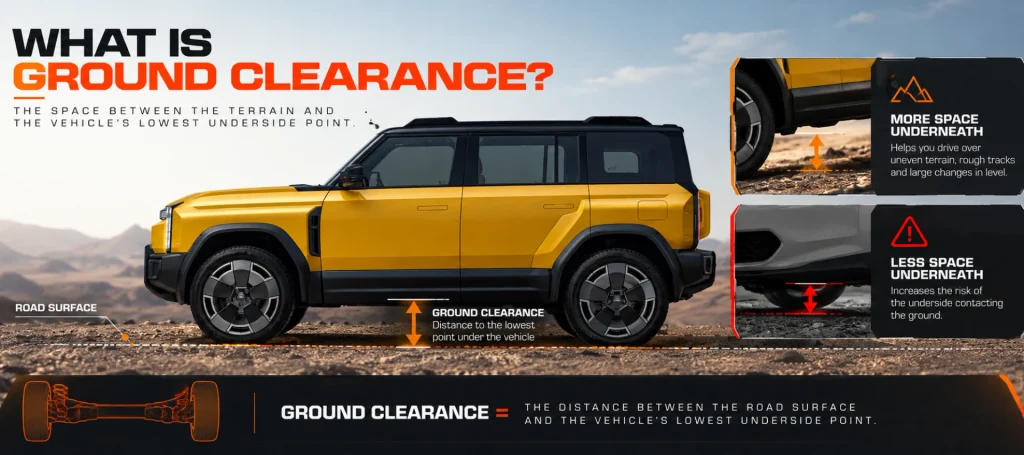
Ground clearance is the distance between the road surface and one of the lowest parts underneath the vehicle.
In simple terms, it tells you how much space there is beneath the SUV before the underside risks contacting the ground.
More clearance can be helpful when driving over:
- Uneven roads
- Rough gravel tracks
- Large changes in road level
- Steep entrances and exits
- Loose or uneven desert surfaces
- Outdoor access roads and campsites
This is one reason adventure-focused SUVs generally sit higher than normal passenger cars.
However, ground clearance should not be viewed as a simple case of “more is always better.”
How Much Ground Clearance Do You Need in Dubai?
For normal Dubai driving, extreme ground clearance is unnecessary.
Most daily journeys take place on well-maintained roads, highways and residential streets. If your SUV spends almost all of its time travelling between home, work, shopping malls and schools, you are unlikely to regularly test the limits of its clearance.
Where extra height becomes useful is when your driving becomes less predictable.
| Driving Situation | How Important Is Ground Clearance? |
|---|---|
| Normal Dubai roads | Low |
| Highway driving | Low |
| Parking ramps | Moderately useful |
| Rough access roads | Useful |
| Gravel tracks | Useful |
| Desert campsites | Very useful |
| Uneven off-road terrain | Very important |
| Serious dune driving | Important, but not enough by itself |
The best ground clearance therefore depends less on the maximum number available and more on how you plan to use the SUV.
Why Ground Clearance Matters on Weekend Trips
This is where the difference becomes easier to understand.
Imagine driving to a desert campsite or an outdoor destination. The paved road ends and the surface becomes rough, with small dips, loose sections and uneven areas.
A low vehicle may require considerably more care because parts underneath the vehicle are closer to the ground.
An SUV with greater clearance gives you more space underneath the vehicle, which can reduce the chance of scraping the underside when travelling across uneven terrain.
For UAE drivers who regularly move between city roads and outdoor destinations, this extra flexibility can be genuinely useful.
What About the iCAUR 03T and V27?
Both current iCAUR SUVs available in Dubai have been designed around this combination of normal road use and adventure capability.
The iCAUR 03T offers 225 mm of ground clearance. Combined with its intelligent AWD system and multiple driving modes, this makes it suitable for drivers who want an everyday SUV that can also handle less predictable surfaces during weekend trips.
The larger iCAUR V27 offers approximately 220 mm of ground clearance along with available AWD and dedicated terrain-focused driving modes.
The difference between 220 mm and 225 mm is relatively small. You should therefore not choose between these SUVs based on those five millimetres alone.
Vehicle size, drivetrain, tyres, suspension, passenger space and the type of driving you intend to do are far more important.
Does Higher Ground Clearance Mean Better Off-Road Ability?
Not automatically.
This is probably the biggest misunderstanding surrounding SUV ground clearance.
A vehicle could sit high above the ground but still be poorly suited to difficult off-road driving.
Real capability depends on several factors working together, including:
- Ground clearance
- AWD or four-wheel-drive capability
- Tyre type
- Suspension design
- Traction control
- Drive modes
- Approach and departure angles
- Power delivery
- Underbody protection
- Driver experience
Ground clearance mainly helps determine how much space the vehicle has between its underside and the terrain.
It does not tell you how much traction the tyres have or how effectively the vehicle can distribute power when driving through loose sand.
This is also why choosing between RWD and AWD should be considered separately. If you regularly leave paved roads, our guide to RWD vs AWD SUVs in Dubai explains when the additional traction of AWD becomes useful.
Ground Clearance Is Not the Same as Wading Depth
These two specifications are also sometimes confused.
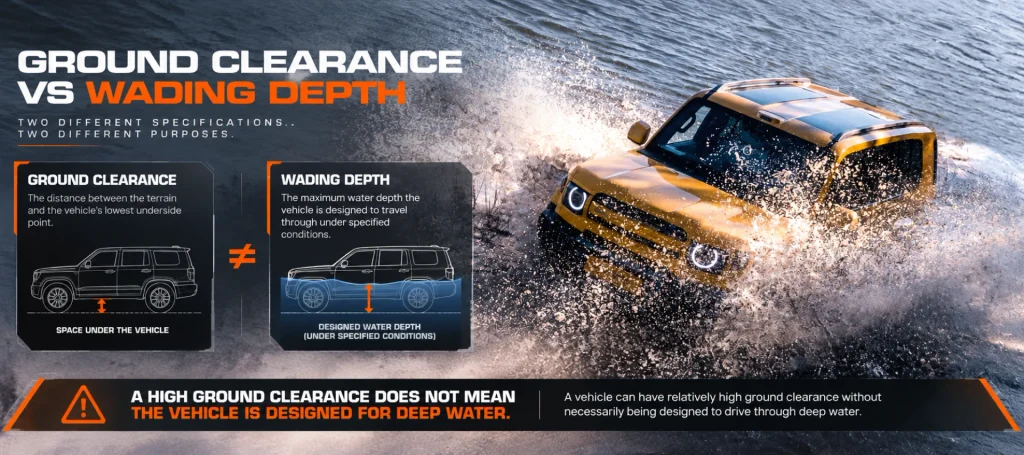
Ground clearance measures how much space exists underneath the vehicle.
Wading depth refers to the maximum water depth the vehicle is designed to travel through under specified conditions.
A vehicle can therefore have relatively high ground clearance without necessarily being designed to drive through deep water.
More importantly, a published wading figure should never be treated as permission to drive into floodwater. Water depth, current, road condition and hidden obstacles can change quickly, particularly during severe weather.
Can Too Much Ground Clearance Be a Disadvantage?
Potentially.
Raising a vehicle changes its centre of gravity, which can influence handling and body movement.
A very tall SUV may also be slightly harder for some passengers to enter and exit.
That is why manufacturers need to balance clearance with suspension tuning, vehicle width, weight distribution and overall chassis design.
For an SUV that spends most of its life in Dubai, the ideal setup is not necessarily the highest possible vehicle. It is enough clearance to provide useful versatility without making everyday driving unnecessarily cumbersome.
What Should You Check During a Test Drive?
Ground clearance itself is difficult to evaluate during a normal road test, but you can still learn a lot about whether an SUV’s overall setup suits you.
Pay attention to how the vehicle feels when:
- Passing over speed humps
- Entering sloped parking areas
- Turning on uneven surfaces
- Driving over imperfect roads
- Getting in and out of the vehicle
- Manoeuvring at low speeds
You should also consider the vehicle’s dimensions and visibility.
A rugged SUV might have excellent ground clearance, but if you spend most of your week using underground parking, its turning behaviour and camera system may matter much more in everyday life.
The best approach is to evaluate the whole vehicle rather than focusing on a single specification.
Do You Need 220+ mm of Ground Clearance?
Not everyone does.
If virtually all of your driving happens on paved roads, you may never fully use that amount of clearance.
But it can provide useful flexibility if your lifestyle includes camping, outdoor trips, rough access roads or occasional driving away from normal tarmac.
That is particularly relevant in the UAE, where the same SUV might spend Monday morning in Dubai traffic and Saturday evening beside a desert campsite.
In that situation, having around 220 mm or more of clearance can make sense — not because you need an extreme off-roader every day, but because the vehicle has more room to adapt when road conditions change.
The Bottom Line
Ground clearance matters, but it should never be considered in isolation.
For normal city driving, you do not need an SUV simply because it sits extremely high off the ground. For drivers who regularly explore beyond paved roads, however, additional clearance becomes much more useful.
The iCAUR 03T and V27 both provide around 220 mm or more of ground clearance, giving them the extra versatility expected from adventure-focused SUVs while remaining designed for everyday road use.
The most important question is therefore not:
“Which SUV has the highest ground clearance?”
It is:
“Where am I actually going to drive it?”
If most of your week happens in Dubai but your weekends sometimes take you beyond the city, that balance between everyday usability and extra capability is what really matters.
You can book an iCAUR test drive in Dubai to compare the 03T and V27 and see which SUV better suits the way you actually drive.