When comparing REEV SUVs, you will see kW and kWh across specification sheets, charging stations and vehicle displays. They look similar, but they tell you different things.
Understanding the difference makes it easier to compare vehicles, and know what to expect when you plug one in.
What Is the Difference Between kW and kWh?
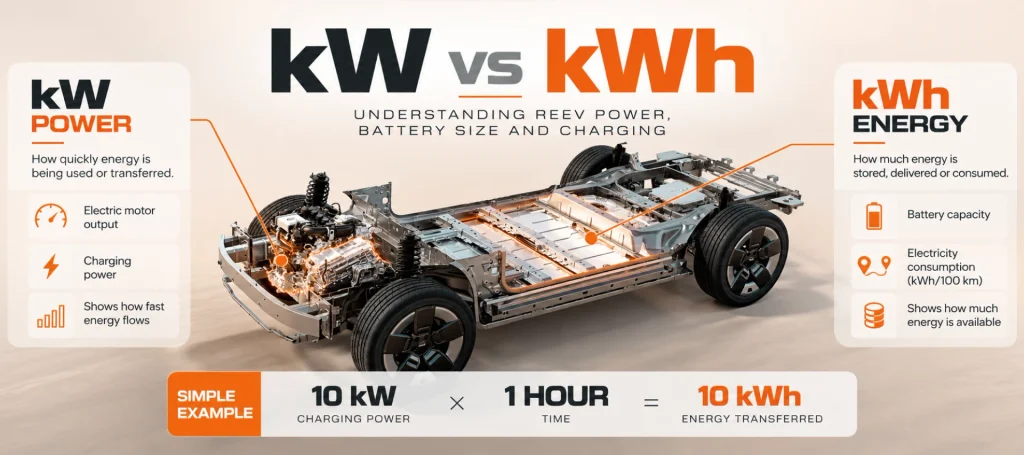
Kilowatts (kW) measure power: how quickly energy is being used or transferred.
Kilowatt-hours (kWh) measure energy: how much is stored, delivered or consumed.
On a vehicle specification sheet, here is how to read them:
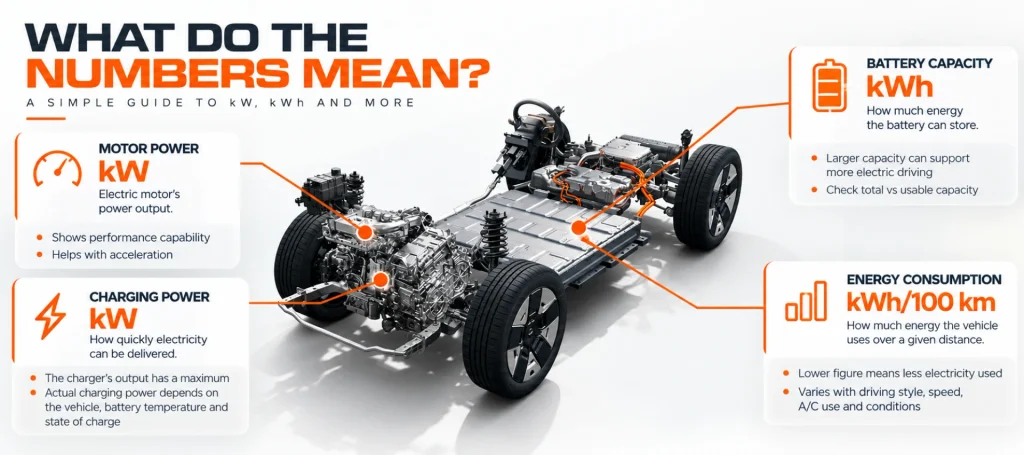
| Specification | Unit | What It Tells You |
|---|---|---|
| Motor power | kW | The electric motor’s power output |
| Battery capacity | kWh | How much energy the battery can store |
| Charging power | kW | How quickly electricity can be delivered |
| Electricity consumption | kWh/100 km | How much energy the vehicle uses over a given distance |

A simple example connects the two: charging at a steady 10 kW for one hour transfers 10 kWh of energy, before allowing for charging losses.
Motor Power: Does More kW Mean More Range?
No. A higher motor power figure indicates greater available power, which can help deliver stronger acceleration. It does not tell you how far the vehicle can travel.
It also does not mean the motor uses its maximum output all the time. Gentle driving requires much less power than strong acceleration.
When comparing performance, consider motor power alongside vehicle weight, torque and whether the SUV uses rear-wheel drive or all-wheel drive.
Battery Capacity: Does More kWh Mean More Driving?
A larger battery generally allows more electric driving when other factors are similar. However, battery capacity alone cannot tell you the range.
Vehicle size, weight, speed, air-conditioning use and driving conditions all affect how quickly that stored energy is used.
For Dubai drivers, that means the same battery charge can last differently during a slow urban commute and a sustained motorway journey.
Also check whether the quoted capacity is total or usable. Total capacity describes the whole battery; usable capacity is the portion the vehicle makes available for normal operation.
In a REEV, battery capacity mainly relates to the electric-only part of the journey. Combined range also includes the contribution of petrol used by the range extender. Our guide to how an iCAUR REEV works explains how the two energy sources support the electric motors.
Charging Power: Will a Higher-kW Charger Always Be Faster?
Only if the vehicle can accept the additional power.
The number on a charging station describes its maximum output. The car has its own charging limit, and actual power can also be affected by the battery’s temperature, charge level and the station’s available supply.
For example, a vehicle accepting 60 kW at that moment will not suddenly receive 150 kW simply because it is connected to a 150 kW charger.
Charging power also changes during a session. This is why a quoted 20–80% charging time is often more useful than the peak charging figure alone. You can read more about why REEV fast charging slows down near 80%.
What Does kWh/100 km Tell You?
This is the electricity equivalent of litres per 100 km. A lower figure means less electricity is used to cover the same distance under comparable conditions.
For example, 20 kWh/100 km means the vehicle uses 20 kWh of electricity to travel 100 km. This is an illustration, not a specification for a particular iCAUR model.
For a REEV, check what the consumption figure describes. An electric-driving figure does not, by itself, account for petrol used when the range extender operates.
Which Numbers Should You Focus On?
Start with how you plan to use the vehicle:
- For your daily commute: compare electric range and electricity consumption.
- For performance: look at motor power, torque and acceleration.
- For charging convenience: check AC charging capability and the stated DC charging time.
- For longer journeys: consider combined range and fuel consumption when the range extender is operating.

When exploring the iCAUR lineup in Dubai, use these figures together. The most useful specification is the one that helps you understand how the SUV will fit your everyday driving.