SUVs are a natural fit for life in Dubai. They offer a higher driving position, generous interior space, strong road presence and the flexibility to handle everything from daily commutes to weekend journeys across the UAE.
However, the same dimensions that make an SUV practical can also make parking more demanding.
Whether you are entering a narrow basement parking area, reversing into a space at a busy shopping mall or navigating a crowded residential street, clear visibility can make a noticeable difference. That is why parking visibility should be considered carefully when choosing your next SUV in Dubai.
A vehicle may look impressive, feel comfortable and include advanced technology, but if it is difficult to judge its surroundings at low speeds, everyday driving can quickly become stressful.
Parking Is Part of Everyday Driving in Dubai
Dubai has wide highways and modern road infrastructure, but drivers still encounter many situations where space is limited.
Shopping malls can become extremely busy during evenings, weekends and public holidays. Apartment buildings may have narrow ramps, concrete pillars and compact parking spaces. Older commercial areas can require drivers to manoeuvre around delivery vehicles, pedestrians and tightly parked cars.
SUV drivers may also need to manage:
- Multi-storey parking facilities
- Underground residential car parks
- Hotel and office valet areas
- School pickup zones
- Crowded supermarket parking spaces
- Tight roadside parking areas
- Charging bays shared by different vehicle types
In these environments, engine power and highway performance are less important than being able to see exactly where the vehicle is positioned.
Good parking visibility helps drivers understand the space around the SUV and make smoother, more confident decisions.
Why SUVs Can Be More Difficult to Park
SUVs usually sit higher than sedans and hatchbacks. This elevated position improves visibility on the road, but it does not automatically make nearby objects easier to see.
The driver may have a good view of traffic ahead while still struggling to see:
- Low barriers near the front bumper
- Pavement edges
- Parking stops
- Small objects behind the vehicle
- Short walls near the corners
- Children or pedestrians close to the SUV
- Vehicles approaching from the side while reversing
Wide bodywork, large pillars and a high bonnet can create areas around the vehicle that are difficult to judge from the driver’s seat.
A sharply styled SUV may also have a rising window line or smaller rear glass area. These design choices can improve the vehicle’s appearance, but they may reduce natural visibility.
This is why SUV buyers should look beyond the seating height and consider how the entire vehicle is designed for low-speed manoeuvring.
A High Driving Position Is Only One Part of Visibility
Many people assume that a higher seating position automatically means better visibility.
It can certainly help when observing the road ahead. Drivers may find it easier to see surrounding traffic, anticipate congestion and understand lane conditions. However, parking visibility involves a different set of requirements.
During parking, the driver needs to judge the SUV’s:
- Front corners
- Rear corners
- Distance from nearby vehicles
- Position within parking lines
- Clearance from kerbs and walls
- Movement of people around the vehicle
A high seating position is useful, but it should be supported by well-positioned windows, practical mirror design, clear camera images and intelligent parking assistance.
The best SUV visibility comes from a combination of physical design and technology.
How a 540-Degree Camera Helps
A 540-degree camera system uses multiple exterior cameras to create a combined view of the area around the vehicle.
Instead of relying only on a reversing camera, the driver can see the SUV from a simulated overhead perspective. This can make it easier to understand where the vehicle sits within a parking space.
In Dubai, a surround-view camera can be particularly useful when:
- Entering a narrow basement ramp
- Parking between two large SUVs
- Driving close to concrete pillars
- Positioning the vehicle near a kerb
- Exiting a crowded mall parking space
- Manoeuvring in an unfamiliar area
A clear camera system can also help drivers avoid unnecessary wheel or bodywork damage caused by kerbs, barriers and low obstacles.
When comparing SUVs, buyers should examine more than whether a 540-degree camera is listed in the specification sheet. The quality of the system matters too.
The display should be clear, responsive and easy to understand. Camera switching should feel natural, and the image should remain useful in both bright daylight and darker parking structures.
Why Camera Resolution and Screen Quality Matter
Not every parking camera provides the same experience.
A low-resolution image may appear unclear in underground parking or during evening driving. Distortion can make objects look closer or farther away than they actually are. A small central display may also make it difficult to notice obstacles near the corners of the vehicle.
A useful parking camera should provide:
- Clear image quality
- Good visibility in low-light conditions
- Accurate parking guidelines
- A wide viewing angle
- Fast activation
- A sufficiently large display
- Easy access to different camera views
Dynamic guidelines are especially helpful because they move as the steering wheel turns. This gives the driver a better idea of the SUV’s expected path while reversing.
During a test drive, buyers should actively test the parking camera rather than simply checking that one is included.
Front and Rear Parking Sensors Add Another Layer of Support
Cameras provide visual information, while parking sensors provide audible or visual warnings as the SUV approaches an obstacle.
Rear sensors are common, but front sensors are equally valuable on an SUV. A high bonnet can make it difficult to judge the exact distance between the front bumper and a low wall, parking barrier or another vehicle.
Front and rear sensors can help reduce this uncertainty.
A well-designed system should make it clear which part of the vehicle is approaching an object. Some systems show the distance visually on the infotainment display, while others change the warning sound as the obstacle gets closer.
Drivers should remember that sensors are assistance tools rather than replacements for observation. Dust, dirt, unusual object shapes and environmental conditions can sometimes affect how accurately a sensor responds.
The most reassuring setup combines cameras, sensors, mirrors and direct observation.
Rear Cross-Traffic Assistance Can Be Valuable in Busy Car Parks
Reversing out of a parking space can be difficult when large vehicles are parked on either side.
The driver may have limited visibility of vehicles, cyclists or pedestrians approaching from the left or right. This is a common challenge in busy shopping centre and supermarket car parks.
Rear cross-traffic alert systems are designed to monitor movement behind the vehicle while it is reversing. If another vehicle is approaching from the side, the system can warn the driver.
Some vehicles may also include rear cross-traffic braking, which can provide additional support when a collision risk is detected.
This type of assistance can be especially useful for an SUV because its size may make it harder to see around neighbouring vehicles.
Mirror Design Still Matters
Advanced cameras are useful, but traditional mirrors remain essential.
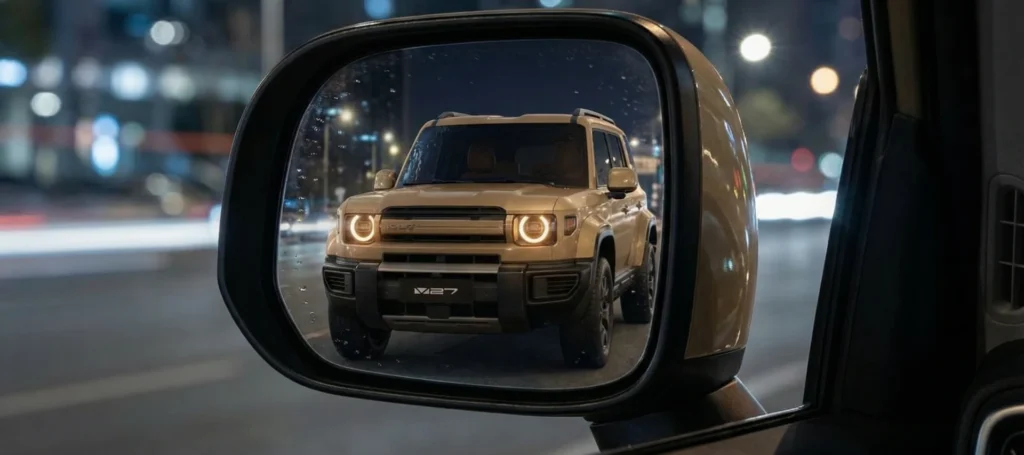
Large, well-positioned side mirrors can help drivers observe parking lines, neighbouring vehicles and the SUV’s rear corners. Some models also include a mirror-tilt function that automatically lowers the mirror angle while reversing, making it easier to see the kerb or parking line.
When evaluating an SUV, pay attention to:
- The size of the side mirrors
- The amount of road visible through them
- Whether the mirror housing creates a blind spot
- The availability of electric adjustment
- Automatic folding functionality
- Blind-spot monitoring
- Mirror tilt while reversing
Power-folding mirrors are particularly practical in narrow parking spaces because they reduce the chance of the mirrors being hit by passing vehicles or pedestrians.
Front Visibility Is Often Overlooked
SUV buyers frequently focus on the reversing camera, but front visibility is just as important.
Some SUVs have tall or heavily styled bonnets. While this can create a strong exterior appearance, it may make it difficult to see objects positioned directly in front of the vehicle.
This matters when approaching:
- Parking stops
- Low concrete walls
- Kerbs
- Children
- Shopping trolleys
- Small vehicles
- Off-road obstacles
A front camera can help the driver judge these areas more accurately. Some surround-view systems can also display the front wheels or side areas, helping drivers avoid scraping alloy wheels against kerbs.
During a test drive, sit in your natural driving position and notice how much of the road immediately in front of the SUV is visible.
Vehicle Shape Influences Parking Confidence
Two SUVs with similar exterior dimensions can feel very different to park.
A vehicle with a more upright body, visible bonnet edges and clearly defined corners may be easier to position than a rounded SUV whose edges cannot be seen from the driver’s seat.
Design details that can improve parking confidence include:
- A relatively upright windscreen
- Large side windows
- Clearly visible bonnet edges
- A wide rear window
- Slimmer pillars
- A predictable body shape
- Good mirror placement
Boxier SUV designs can sometimes make the vehicle’s dimensions easier to understand because the corners feel more clearly defined. However, technology should still support the driver where direct visibility is limited.
Visibility Becomes More Important as Vehicle Size Increases
A compact SUV may be relatively easy to place within a parking space, while a larger family or adventure SUV may require more attention.
Before choosing a larger vehicle, consider where you normally park.
A full-size SUV may suit long journeys, family travel and outdoor activities, but buyers who regularly use compact residential or office parking should make sure the vehicle includes strong visibility features.
Important dimensions to compare include:
- Overall length
- Overall width
- Width with mirrors
- Wheelbase
- Turning circle
- Ground clearance
The turning circle is particularly relevant in narrow car parks. A smaller turning circle can reduce the number of adjustments needed when entering a space or turning between ramps.
Parking Visibility Can Reduce Everyday Stress
Parking assistance is not simply about preventing scratches.
A vehicle that is easy to position can make every journey feel more relaxed. Drivers may feel more comfortable visiting busy destinations, using underground parking and sharing the vehicle with family members who have different levels of driving experience.
Good visibility can help with:
- Faster parking
- Smoother manoeuvres
- Better awareness of pedestrians
- Reduced risk of wheel damage
- Greater confidence in narrow spaces
- Less dependence on passengers for guidance
This becomes especially important when the SUV is used every day.
A feature that saves only a few minutes during each journey can still make a significant difference over years of ownership.
What to Check During an SUV Test Drive
Parking visibility should be tested in a realistic environment.
Rather than driving only on a wide road, ask to park the SUV during the test drive. Try reversing into a space, approaching a kerb and moving through a tighter area.
Check whether you can easily understand the vehicle’s dimensions. Notice how quickly the camera activates and whether the image remains clear.
You should also test:
- Front and rear camera views
- Surround-view display
- Parking guidelines
- Front and rear sensors
- Rear cross-traffic warnings
- Side-mirror visibility
- Steering effort at low speed
- Turning circle
- Visibility through the rear window
Adjust the seat and mirrors before making a judgement. Visibility can feel very different depending on the driver’s height and seating position.
Do Not Choose an SUV Based Only on Its Exterior
SUV design plays an important role in the buying decision. Drivers naturally want a vehicle that matches their lifestyle and feels distinctive on Dubai roads.
However, visual appeal should not come at the expense of everyday usability.
An SUV should feel impressive when seen from outside, but it should also feel manageable from behind the wheel. The ideal vehicle combines confident styling with practical visibility, intelligent cameras and driver-assistance technology.
A dramatic exterior may attract attention in the showroom. Clear parking visibility is what makes the vehicle easier to live with every day.
Choosing an SUV for Dubai Life
The right SUV for Dubai should work confidently in several different environments.
It should feel stable on Sheikh Zayed Road, comfortable during longer UAE journeys and manageable inside a crowded mall or residential car park.
When comparing vehicles, look for a balanced package that includes:
- A comfortable driving position
- Clear natural visibility
- High-quality parking cameras
- Front and rear sensors
- Surround-view monitoring
- Rear cross-traffic assistance
- Practical mirror design
- Predictable low-speed steering
These features can be just as valuable as performance, interior technology and cargo space.
Final Thoughts
Parking visibility may not be the most exciting feature discussed when buying an SUV, but it is one of the features drivers use most frequently.
Dubai’s mix of highways, shopping centres, residential towers, hotels and busy commercial areas means SUV owners regularly move between open roads and confined parking spaces. A vehicle that offers clear visibility and effective parking assistance can make these transitions easier and safer.
Before choosing your next SUV, do more than examine the exterior and review the specification list. Sit in the driver’s seat, adjust the mirrors, activate the cameras and test the vehicle in a real parking space.
An SUV should not only look ready for the road. It should also give you the confidence to handle the smaller spaces you encounter every day.
Explore the latest iCAUR SUVs in Dubai and book an iCAUR test drive to experience their visibility, intelligent technology and everyday usability for yourself.