You stop at a traffic light, lift your foot off the brake, and the car stays still. Later, you park and press a small switch instead of pulling a handbrake lever.
Both features hold the vehicle in place, but they serve different purposes. Auto Hold helps during temporary stops while you are driving. The electronic parking brake secures the vehicle when you park.
For drivers in Dubai, where a journey can involve busy junctions, slow queues and multi-storey parking, knowing how each works can make everyday driving more comfortable and prevent confusion when it is time to leave the car.
What Does Auto Hold Do?
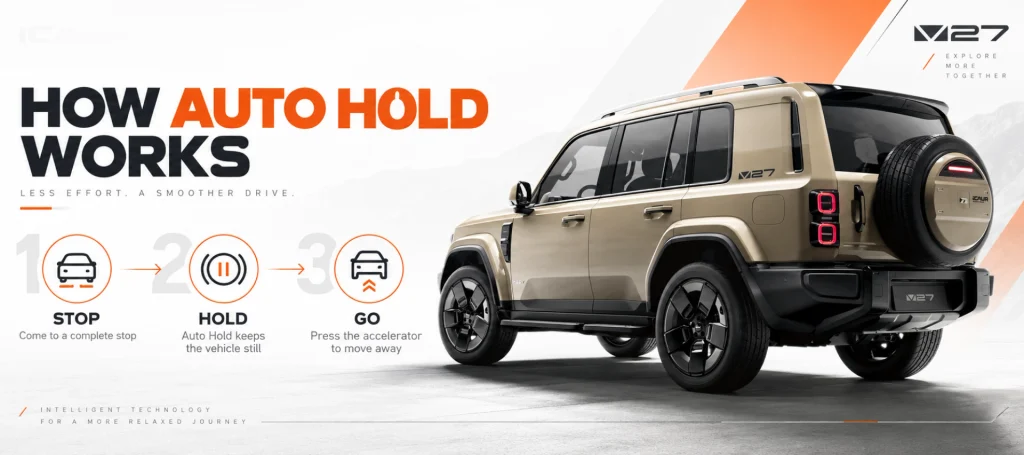
Auto Hold maintains braking force after you bring the vehicle to a complete stop, allowing you to take your foot off the brake pedal while waiting.
You usually enable it through a button or the vehicle’s settings. Once its operating conditions are met, the system holds the brakes at a standstill. In many vehicles, a gentle press of the accelerator releases the hold so you can move away.
Its benefits are most noticeable at ordinary stops: a red light, a stationary queue or traffic that moves a few metres at a time. Instead of keeping steady pressure on the brake pedal throughout the wait, you can rest your foot while remaining ready to control the vehicle.
Auto Hold does not decide when it is safe to move, and it does not drive through traffic for you. You still need to watch the road, maintain a suitable gap and control each move forward.
What Does the Electronic Parking Brake Do?
The electronic parking brake, often abbreviated to EPB, performs the parking-brake function through an electrical control rather than a conventional handbrake lever or pedal.
Its main purpose is to keep the vehicle secured when parked. Depending on the model, you can apply it using a switch, and it may also engage automatically under certain conditions.
Automatic release is available on some vehicles too, provided the required conditions are met. Others require you to press the brake pedal and operate the parking-brake control before moving away.
Although Auto Hold and the EPB have different roles, they can work together. Some vehicles transfer from Auto Hold to the parking brake after an extended stop or when conditions change. The timing and triggers vary, so it is worth understanding how your own vehicle behaves rather than expecting every car to operate in the same way.
| Feature | Auto Hold For temporary stops | Electronic Parking Brake For parking |
|---|---|---|
| Main purpose | Holds the vehicle during temporary stops. | Secures the vehicle when parked. |
| Typical use | Traffic lights and stationary queues. | Parking at the end of a journey. |
| How it engages | After stopping, when enabled and its operating conditions are met. | Through its control or automatically under model-specific conditions. |
| How it releases | Often when the driver presses the accelerator. | Through its control or an automatic release function, depending on the vehicle. |
| What the driver should do | Remain seated, attentive and ready to control the vehicle. | Complete the parking procedure and confirm the brake is applied before leaving. |
Remember: Auto Hold is not a substitute for parking properly. Follow your vehicle’s parking procedure and confirm that the parking brake is engaged before getting out.
Can You Leave the Car While Auto Hold Is Active?
Do not rely on Auto Hold when getting out of the vehicle.
Opening a gate or collecting something nearby may only take a moment, but you still need to park properly. Follow the vehicle’s parking procedure, select Park where applicable and confirm that the parking brake is engaged before leaving the driver’s seat.
Some systems automatically apply the EPB when the driver’s door opens, the seat belt is released or another operating condition changes. Those functions are model-dependent and should not replace checking that the vehicle is secured.
Manufacturer guidance distinguishes Auto Hold from parking and instructs drivers to apply the parking brake before leaving the vehicle.
Why Is Auto Hold Switched On but Not Holding?
There is a difference between enabling Auto Hold and having an active hold.
Enabling the feature makes it available. The system must then recognise a suitable stop and meet its activation conditions before it holds the brakes.
Depending on the vehicle, those conditions may include:
- A closed driver’s door and a fastened seat belt.
- A suitable gear or drive selection.
- The vehicle reaching a complete standstill.
- Sufficient pressure on the brake pedal.
A light touch on the pedal may not activate the hold in the same way as a firm, complete stop. Some manufacturer instructions specifically identify sufficient brake pressure as an activation requirement.
The instrument display may use different colours, symbols or messages to distinguish between the system being available and actively holding. Learn those indicators before relying on the feature. A light on the Auto Hold button does not necessarily confirm that the brakes are currently holding the car.
If the vehicle asks you to press the brake pedal, do so promptly. Your owner’s manual explains the exact indicators and operating conditions for your model.
What Should You Do in an Automatic Car Wash?
The type of car wash matters.
In a conveyor-type wash, the equipment moves the vehicle through the washing area, so the wheels need to roll freely. Auto Hold or an automatically applied parking brake can interfere with that movement.
Before entering, follow your vehicle’s car-wash procedure and the operator’s instructions. This may involve disabling Auto Hold, selecting Neutral and using a dedicated Car Wash Mode or a procedure that keeps the vehicle in Neutral.
Do not assume that selecting Neutral disables every automatic braking function. Manufacturer guidance commonly includes instructions to switch off Auto Hold before using an automatic car wash.
A wash that keeps the vehicle stationary may require a different setup. Check which type you are entering before changing the vehicle’s settings.
Our guide to taking a REEV through an automatic car wash explains the other functions to check, including automatic wipers and any available wash mode.
Get Familiar with Both Features During a Test Drive
These controls are easier to understand when someone demonstrates them in the vehicle you are considering.
During an iCAUR showroom visit, ask the team to show you the functions available on your chosen model and trim. Find out where Auto Hold is enabled, which indicator confirms that it is holding, how the vehicle moves away and how to check that the parking brake is applied.
If you are exploring the iCAUR V27, include these everyday controls in your questions alongside cabin space, driving comfort and charging.
A few minutes spent learning them can make the first journey feel more familiar. Use Auto Hold to make temporary stops more comfortable, and follow the full parking procedure whenever you leave the vehicle.